
Poor bacteria.
Honestly, they’ve got one of the worst reputations on Earth.
Say the word bacteria out loud and watch what happens.
People immediately start thinking about dirty hands, food poisoning, infections, public toilets, and that one friend who never washes their water bottle.
Nobody has ever excitedly shouted, “Yes! More bacteria, please!”
Which is understandable.
For years, we’ve been taught that bacteria are bad. Kill the bacteria. Wash away the bacteria. Spray something on the bacteria. If the advert says it kills 99.9% of bacteria, we assume that’s a good thing.
But here’s something that completely changed the way I think about my own body.
Right now, as you’re reading this, trillions of bacteria are living on and inside you.
Not hundreds.
Not thousands.
Not even millions.
Trillions.
Take a second to let that sink in.
If that sentence makes you want to take another bath, don’t worry. I had the same reaction the first time I learned it.
But here’s the twist.
Most of those bacteria aren’t trying to harm you.
In fact, many of them have been quietly helping you for your entire life.
Imagine finding out that the neighbours you’ve been suspicious of all these years have actually been watering your plants while you were away.
That’s basically what’s happening inside your body.
We like to think of ourselves as individuals.
One body.
One person.
Simple.
The truth is a little stranger.
You’re more like a busy little city.
There are trillions of tiny living things sharing that city with you.
Scientists call this your microbiome, but don’t let the fancy name scare you. It’s simply the enormous community of microorganisms that live in places like your gut, your mouth, your skin, and even inside your nose.
Some are just passing through.
Some have lived there for years.
Some arrived before you could even walk.
It’s like your body quietly built an entire neighbourhood without ever asking for planning permission.
Let’s give these tiny helpers the credit they deserve.
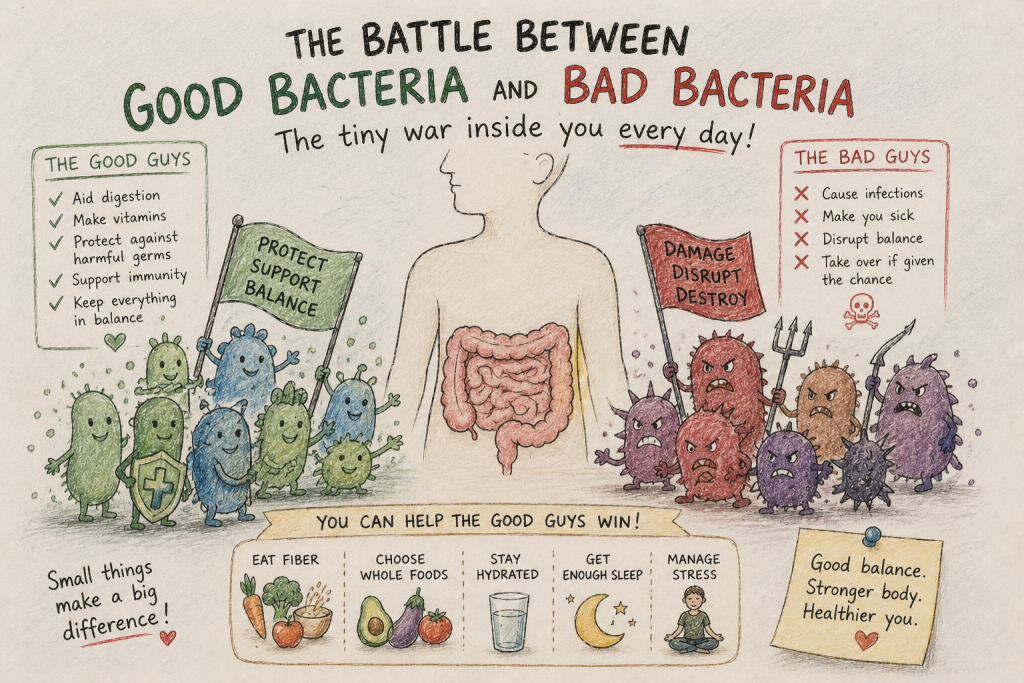
Some bacteria help you digest food.
Others produce vitamins that your body needs.
Some help train your immune system so it knows the difference between a harmless visitor and a genuine threat.
Others simply occupy space, making life much harder for dangerous bacteria that would love to move in.
Think of them as good neighbours.
They keep the place tidy.
They look out for trouble.
And because they’re already living there, there’s very little room left for the troublemakers to settle down.
Not a bad arrangement, if you ask me.
Of course, not every bacterium deserves a thank-you card.
Some really do make people sick.
These are the ones that can cause infections, food poisoning, pneumonia, urinary tract infections, and many other illnesses.
They’re the reason doctors sometimes prescribe antibiotics.
They’re also the reason your immune system never truly gets a day off.
It’s always watching.
Always checking.
Always asking, “Friend or foe?”
Honestly, if our immune system had eyes, it would probably never blink.
Here’s where the story gets interesting.
Imagine your neighbourhood has a few criminals causing problems.
The police arrive… but instead of arresting only the criminals, everybody gets rounded up.
The good neighbours.
The bad neighbours.
Even the old woman watering her flowers.
That’s a little like what some antibiotics do.
They save lives. Let’s be very clear about that.
Modern medicine would look completely different without them.
But while they’re dealing with the harmful bacteria, they can also reduce some of the helpful ones.
That’s one reason doctors remind us not to take antibiotics unless they’re actually needed, and why finishing the prescribed course is so important.
Medicines work best when we use them wisely.
So… should we stop washing our hands?
Absolutely not.
Nice try.
This isn’t permission to abandon soap.
Good bacteria are wonderful, but so is basic hygiene.
Washing your hands before eating, after using the toilet, or after coming home from crowded places remains one of the simplest ways to prevent illness.
The goal isn’t to live in a bubble.
The goal is balance.
Your body is perfectly capable of living alongside billions of friendly bacteria.
What it doesn’t need is extra help from the harmful ones.
Can we help the good bacteria?
Actually, yes.
And it’s probably simpler than you think.
Those helpful bacteria enjoy many of the same things that are good for us.
A varied diet.
Fruits.
Vegetables.
Beans.
Whole grains.
Foods rich in fibre.
These provide fuel for the beneficial bacteria living in your gut.
It’s a bit like feeding the good team so they stay strong enough to keep doing their jobs.
On the other hand, constantly living on highly processed foods with very little fibre isn’t doing them many favours.
Your gut community notices your eating habits almost as much as you do.
Here’s my favourite part of this whole story
For most of human history, we couldn’t even see bacteria.
People had no idea they existed.
Yet all this time, these tiny organisms have been living with us, helping us digest food, training our immune system, protecting our bodies, and quietly getting on with their work.
No applause.
No recognition.
Just showing up every single day.
It makes you realise something.
The human body isn’t just amazing because of the organs we can name.
It’s amazing because of the tiny partnerships we never notice.
So the next time you hear the word bacteria, don’t automatically think “enemy.”
Some certainly are.
But many are loyal teammates that have been working for you since the day you entered this world.
And honestly, that’s one of the coolest things I’ve learned about the human body.
It turns out that one of the biggest battles for your health isn’t happening in hospitals or laboratories.
It’s happening quietly, every single day, inside you.
And thankfully, most days, the good guys are winning.
🧠 Curious Fact of the Week
Did you know your belly button has its own tiny community of bacteria?
Scientists have found that no two people’s belly buttons contain exactly the same mix of microorganisms. In fact, researchers have identified thousands of different bacterial species living there. Most of them are completely harmless and simply mind their own business.
Your body really is an entire world of its own.
📰 Want every new article delivered to your inbox?
Subscribe here:
Stay Informed