
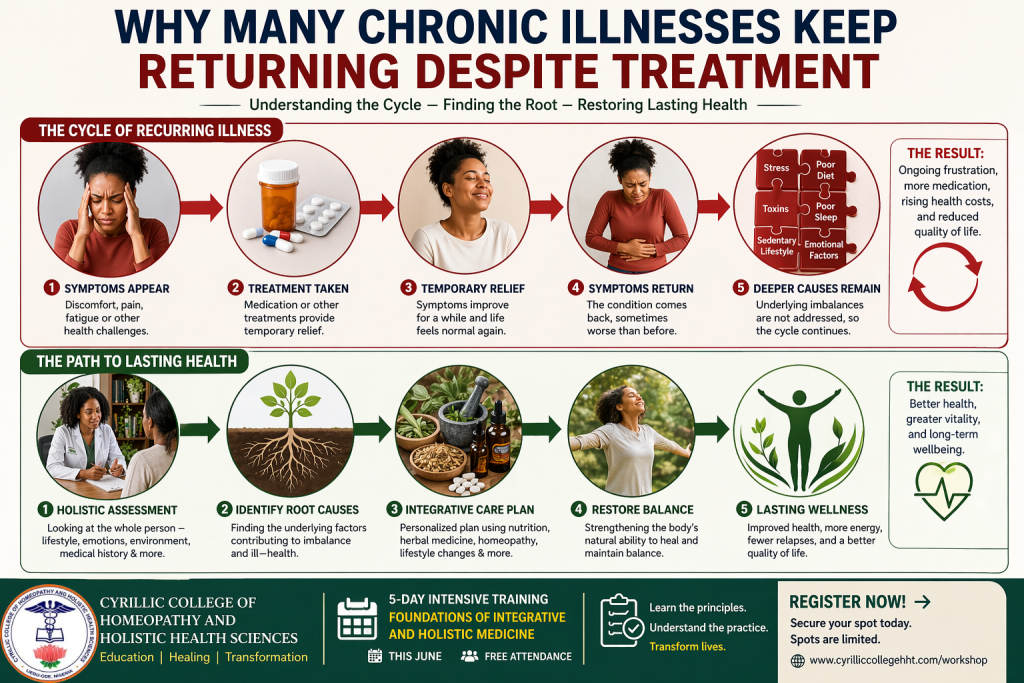
One of the most common frustrations patients experience today is the feeling that certain health problems never fully go away.
A person receives treatment, symptoms improve for a while, and life seems normal again. Then, weeks or months later, the same condition returns. Sometimes the symptoms are milder, sometimes stronger, but the pattern continues.
Recurring digestive discomfort, persistent headaches, repeated infections, chronic fatigue, skin conditions, allergies, and inflammatory disorders are just a few examples of conditions that many people struggle to keep under control despite treatment.
This does not necessarily mean that the treatments being used are ineffective. In many cases, they may provide important relief and help manage symptoms.
However, when illnesses continue to return repeatedly, it often suggests that something deeper may still be influencing the body’s health.
Understanding this possibility is one of the key ideas behind integrative and holistic approaches to healthcare.
The Difference Between Treating Symptoms and Understanding Causes
Modern medicine has made extraordinary progress in diagnosing and managing disease. Many conditions that once caused severe disability or death can now be controlled through medication and advanced therapies.
But healthcare is complex. Symptoms are not always the same as causes.
A headache, for example, might be relieved with medication. Yet the underlying trigger might still be present. Stress, poor sleep, dehydration, hormonal changes, eye strain, digestive issues, or nutritional imbalances could all contribute to recurring headaches.
Similarly, digestive discomfort might be temporarily relieved with medication, but the original trigger might involve diet patterns, gut microbiome imbalance, chronic stress, or food sensitivities.
When the underlying influences remain unaddressed, symptoms may return once treatment stops.
This is why many healthcare practitioners are increasingly interested in approaches that look beyond immediate symptom relief to explore deeper patterns in the body.
Chronic Illness Often Has Multiple Contributing Factors
Unlike acute illnesses, which usually have a clear cause, many chronic health conditions develop gradually over time.
They may involve several overlapping influences such as:
Lifestyle habits
Diet and nutrition
Stress levels
Sleep patterns
Environmental exposures
Genetic predisposition
Hormonal balance
Emotional wellbeing
These factors interact in complex ways. When several of them combine, they can gradually disturb the body’s natural balance.
Over time, this imbalance may manifest as recurring symptoms or chronic conditions.
If only one piece of the puzzle is addressed while others remain unchanged, the body may continue to struggle with the same patterns.
The Body’s Natural Regulatory Systems
The human body is designed with remarkable systems that regulate balance and maintain health.
Immune responses help protect against infection. Hormonal systems regulate metabolism and energy. The nervous system coordinates communication between organs. Digestive processes transform nutrients into the building blocks of life.
When these systems are functioning well, the body can often correct minor disturbances on its own.
But when stress, lifestyle factors, environmental influences, or long standing imbalances interfere with these regulatory systems, symptoms may begin to appear.
Holistic healthcare approaches often focus on supporting these natural regulatory mechanisms rather than addressing symptoms in isolation.
A Broader Way of Understanding Health
This perspective is part of what defines integrative and holistic healthcare.
Rather than viewing illness as a collection of disconnected symptoms, practitioners attempt to understand the broader patterns that may be affecting a person’s wellbeing.
This process often involves detailed case taking, where practitioners explore areas such as:
Daily routines and lifestyle habits
Nutrition and dietary patterns
Sleep quality
Emotional stress
Environmental influences
Personal medical history
By examining these interconnected factors, practitioners can begin to identify patterns that might not be obvious when looking only at symptoms.
This deeper understanding can guide more individualized strategies for improving health.
The Role of Natural Therapeutic Systems
Many integrative healthcare approaches also draw upon therapeutic systems that have long histories in traditional and complementary medicine.
These may include methods such as homeopathy, herbal medicine, nutritional therapy, lifestyle medicine, and other holistic modalities.
Each system approaches healing in its own way, but many share a common principle: supporting the body’s capacity to restore balance.
Rather than focusing only on suppressing symptoms, these methods often aim to strengthen the body’s regulatory systems and address underlying imbalances.
When used responsibly and appropriately, such approaches can complement modern medical care and provide additional tools for managing chronic health challenges.
The Importance of Individualized Care
Another important principle in holistic healthcare is the recognition that no two patients are exactly alike.
Even when two individuals share the same diagnosis, the factors contributing to their condition may be completely different.
For example, two people experiencing chronic fatigue may have very different underlying influences. One person’s fatigue may be connected to stress and sleep disruption, while another person’s symptoms may relate to nutritional deficiencies or hormonal imbalance.
Because of these differences, effective treatment strategies often need to be individualized.
Holistic practitioners therefore place significant emphasis on understanding the unique circumstances surrounding each patient’s health.
Learning to Think Like an Integrative Practitioner
For those interested in understanding this broader approach to healthcare, education and training are essential.
Learning how practitioners analyze complex health patterns, evaluate patient history, and design individualized treatment strategies requires structured guidance and practical examples.
This is why educational programs that introduce the principles of integrative medicine are becoming increasingly valuable.
Upcoming Training Opportunity
This June, Cyrillic College of Homeopathy and Holistic Health Sciences will host a 5 Day Intensive Training on the Foundations of Integrative and Holistic Medicine.
The program is designed to provide participants with an introduction to key areas of integrative healthcare, including:
The philosophy of holistic medicine
Clinical thinking and patient assessment
Natural therapeutic systems such as homeopathy and herbal medicine
Integrative treatment planning
Professional pathways in holistic healthcare
Participants will have the opportunity to learn directly from experienced practitioners who have worked extensively in the field.
Attendance at the workshop is free, and participants who wish to obtain certification will have the option to do so upon completion.
For anyone curious about how integrative healthcare practitioners approach chronic illness and complex health conditions, this training provides an excellent opportunity to explore these ideas in greater depth.
Looking Beyond Recurring Symptoms
Recurring illness can be frustrating, both for patients and for practitioners seeking to provide effective care.
Understanding why certain conditions return repeatedly often requires looking beyond symptoms and exploring the broader influences affecting health.
Integrative medicine encourages this deeper perspective, combining careful observation, individualized care, and a wide range of therapeutic tools to support long term wellbeing.
For those interested in learning how these approaches work in real clinical practice, the upcoming intensive training offers a valuable starting point.
Reserve your place today.
Attendance is free.
Registration link:
https://docs.google.com/forms/d/e/1FAIpQLSfDKIHIlPeSdn3d-RUBrVTqky5U5RZelhSZ_lSUEGBSYKUYrQ/viewform?usp=header