
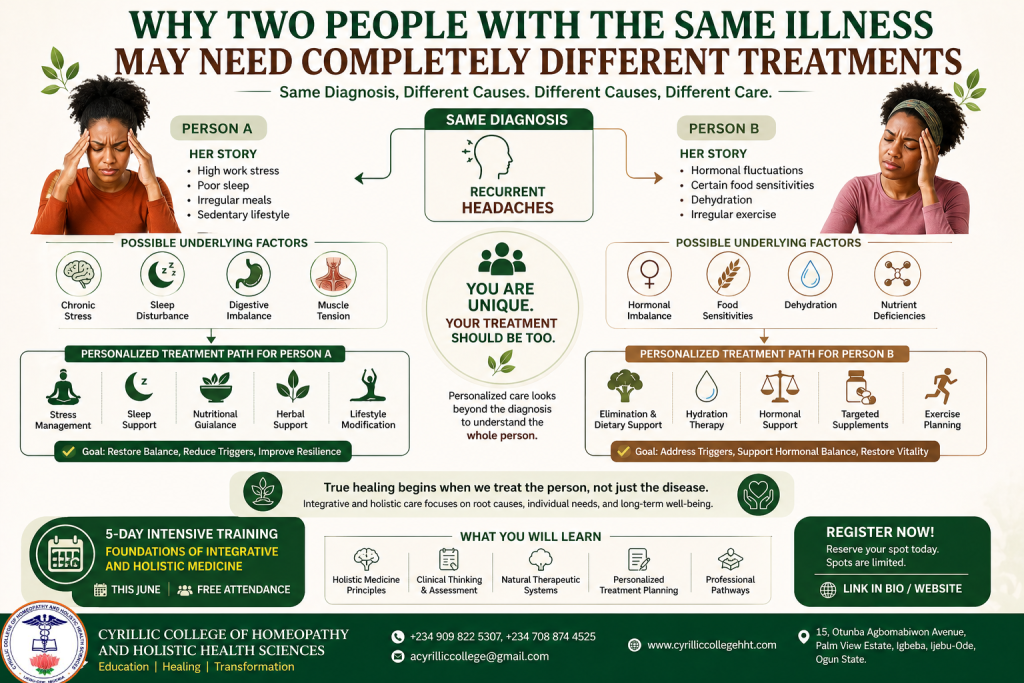
It is a common assumption in healthcare that if two people have the same diagnosis, they should receive the same treatment.
At first glance, this seems logical. If the condition is the same, then the solution should also be the same.
However, in real clinical practice, things are rarely that simple.
Two individuals can present with the same illness on paper, yet experience completely different symptoms, triggers, and underlying causes. As a result, they may respond very differently to the same treatment.
This is one of the key ideas behind holistic and integrative healthcare, the recognition that each patient is unique, and effective treatment often needs to reflect that individuality.
The Limits of One-Size-Fits-All Treatment
Modern medicine has achieved remarkable success in standardizing treatment protocols. These protocols are essential, especially in acute care and emergency situations where quick, decisive action is needed.
But when it comes to chronic conditions and long-term health challenges, a one-size-fits-all approach can sometimes fall short.
Take a common condition like migraine headaches.
Two patients may both be diagnosed with migraines, yet their experiences can differ significantly:
One may experience migraines triggered by stress and poor sleep
Another may have migraines linked to hormonal changes
A third may react to certain foods or digestive disturbances
If all three individuals receive the same treatment without considering these differences, the results may vary widely.
Some may improve, others may not.
Understanding the Individual Patient
Integrative healthcare approaches this challenge by looking beyond the diagnosis itself and focusing on the individual behind it.
Practitioners aim to understand:
The patient’s lifestyle and daily routines
Diet and nutritional patterns
Stress levels and emotional wellbeing
Sleep quality
Environmental influences
Personal and family health history
These factors often interact in complex ways, shaping how illness develops and how the body responds to treatment.
By exploring these details, practitioners can begin to see patterns that are unique to each patient.
The Role of Root Cause Thinking
Another important aspect of individualized care is the search for underlying causes.
Symptoms are often signals that something within the body is out of balance. But those signals can arise from different sources in different people.
For example, two individuals with digestive discomfort might share the same diagnosis, yet the underlying causes could be very different:
One may have food sensitivities
Another may be experiencing chronic stress affecting digestion
A third may have an imbalance in gut microbiota
Treating all three in the same way may not address the root of the problem.
Holistic and integrative practitioners therefore aim to identify these deeper influences and design treatment strategies accordingly.
Different Bodies, Different Responses
Human biology is inherently variable.
Factors such as genetics, metabolism, immune function, and hormonal balance can influence how the body responds to both illness and treatment.
This is why a medication or therapy that works well for one person may be less effective for another.
It also explains why some individuals recover quickly while others take longer, even when receiving similar care.
Recognizing this variability is essential for developing more effective and sustainable approaches to healthcare.
The Importance of Personalized Treatment Plans
Individualized care leads naturally to personalized treatment planning.
Rather than applying a uniform approach, practitioners design strategies tailored to the patient’s specific needs.
These plans may include:
Nutritional adjustments
Lifestyle modifications
Stress management strategies
Natural therapeutic systems such as homeopathy or herbal medicine
Support for sleep and overall wellbeing
The goal is not only to relieve symptoms but also to support the body’s ability to maintain balance over time.
A More Comprehensive Approach to Healing
Holistic medicine does not reject conventional healthcare. Instead, it seeks to expand the way we think about treatment.
By combining medical knowledge with a deeper understanding of individual variability, integrative healthcare aims to provide more comprehensive and patient-centered care.
This approach is particularly valuable in managing chronic conditions, where multiple factors often contribute to illness.
Learning to Apply Individualized Care in Practice
Understanding the concept of individualized treatment is one thing. Learning how to apply it in real clinical situations is another.
Practitioners must develop the ability to:
Gather detailed patient information
Identify patterns within complex data
Analyze possible contributing factors
Design appropriate treatment strategies
These skills require training, practice, and guidance from experienced professionals.
Upcoming Training Opportunity
To support individuals interested in learning these approaches, Cyrillic College of Homeopathy and Holistic Health Sciences will be hosting a 5 Day Intensive Training on the Foundations of Integrative and Holistic Medicine this June.
The program is designed to introduce participants to:
The principles of holistic and integrative healthcare
Clinical thinking and patient assessment
Natural therapeutic systems such as homeopathy and herbal medicine
Personalized treatment planning
Professional pathways in integrative healthcare
Participants will have the opportunity to learn from experienced practitioners and gain insight into how individualized care is applied in real practice.
Attendance is free, and those who wish to obtain certification will have the option to do so upon completion.
A Shift Toward Personalized Healthcare
As healthcare continues to evolve, there is growing recognition that effective treatment often requires a more personalized approach.
Two people may share the same diagnosis, but their journey toward health may look very different.
Understanding and respecting this individuality is one of the key strengths of integrative medicine.
For those who are curious about how these principles are applied in clinical practice, the upcoming intensive training offers an excellent opportunity to explore this field further.
Reserve your place today.
Attendance is free.
Registration link: https://docs.google.com/forms/d/e/1FAIpQLSfDKIHIlPeSdn3d-RUBrVTqky5U5RZelhSZ_lSUEGBSYKUYrQ/viewform?usp=header