There are very few things more confidently diagnosed in Nigerian homes than malaria.
You can wake up slightly tired and somebody will say:
It is malaria.
Headache?
Malaria.
Body pain?
Malaria.
Feeling cold during rain?
Malaria.
Yawning too much?
Possible malaria.
At some point, many Nigerians grew up believing malaria was less of a disease and more of a permanent roommate.
The funny part is how quickly the diagnosis usually arrives. Sometimes before the sick person even finishes explaining the symptoms.
A Nigerian parent can hear:
“My throat feels strange”
and somehow still arrive at:
“Malaria.”
No laboratory test.
No hesitation.
No second opinion.
Just pure parental certainty.
For many people, childhood memories of illness are almost inseparable from:
- bitter drugs
- mosquito lectures
- sweaty nights
- forced pap
- aggressive hydration
- and somebody saying:
“You did not sleep under the net.”
Then there was the classic situation where every treatment somehow included the same lineup:
paracetamol, malaria drugs, glucose, tea, rest, and enough concern to make you feel either loved or slightly frightened.
Even when the illness had absolutely nothing to do with malaria.
But beneath the humor, there is actually a reason malaria became culturally attached to almost every sickness in Nigeria.
For decades, malaria genuinely was everywhere.
And not just mildly everywhere.
Aggressively everywhere.
People grew up in environments where recurring fever, body pain, weakness, headaches, and chills were extremely common experiences. Entire households could fall sick around the same period. Missing school because of malaria was practically a seasonal event.
Over time, malaria stopped feeling like a specific diagnosis and became something broader:
a national explanation for feeling unwell.
That habit stayed.
Even now, many symptoms overlap so easily with stress, exhaustion, viral infections, poor sleep, dehydration, or other illnesses that people still default automatically to:
“It is probably malaria.”
Sometimes they are right.
Sometimes they are very wrong.
And Nigerians are not exactly known for calmly observing symptoms before self-medicating.
The average Nigerian medicine drawer looks like somebody is preparing for a small pharmaceutical emergency.
Some people start treatment before confirming anything.
Others combine recommendations from:
- parents
- pharmacists
- neighbors
- church members
- one uncle who “knows medicine”
- and occasionally TikTok.
At that point, the body itself is probably confused.
One of the more interesting things about Nigerian health culture is how communal it is. Illness rarely belongs to only one person. The moment somebody says they are not feeling fine, five people suddenly become involved emotionally.
Advice starts flying everywhere.
Drink water.
Eat first.
Sweat it out.
Take agbo.
Rest.
Do not rest too much.
Use garlic.
Avoid cold water.
Sleep.
Take vitamins.
Check your temperature.
It is stress.
No, definitely malaria.
Sometimes the concern is funny.
Sometimes overwhelming.
But often, it also reflects something deeply human about Nigerian society.
People genuinely care.
Even if the diagnosis accuracy occasionally sounds like gambling.
Interestingly, younger Nigerians are beginning to question some of these automatic assumptions more than previous generations did. People are reading more about health online, asking more questions, paying attention to nutrition, stress, sleep, hormones, digestion, mental health, and preventive care in ways that were less common years ago.
At the same time, modern health culture has also created new confusion.
Now people diagnose themselves with things after three Google searches and one alarming TikTok video.
So in some strange way, Nigeria moved from:
everything is malaria
to:
everything is either hormonal imbalance, ulcer, anxiety, vitamin deficiency, or inflammation.
The national diagnostic confidence remains strong.
Only the vocabulary changed.
Still, one positive thing is becoming clearer.
More people are beginning to realize that health is often more complicated than one quick explanation. Fatigue may not always be malaria. Headaches may involve stress, sleep, dehydration, eyesight, or tension. Constant tiredness may come from lifestyle habits people barely notice daily.
The body is usually telling a larger story than people first assume.
That growing curiosity about health, lifestyle, and holistic wellbeing is part of why conversations around integrative healthcare have expanded significantly in recent years.
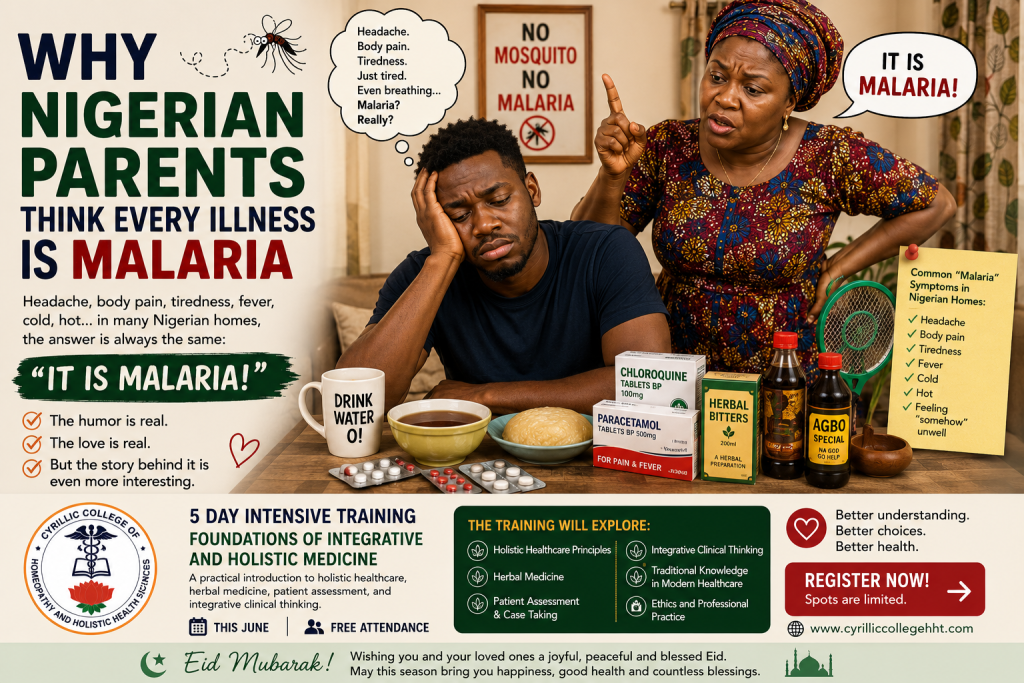
This June, Cyrillic College of Homeopathy and Holistic Health Sciences will host a 5 Day Intensive Training on Foundations of Integrative and Holistic Medicine.
The workshop will explore broader approaches to health, patient assessment, holistic healthcare principles, and integrative thinking in modern practice.
Attendance is free.
And yes, before anybody asks:
not every headache is malaria.
Registration link:
https://docs.google.com/forms/d/e/1FAIpQLSfDKIHIlPeSdn3d-RUBrVTqky5U5RZelhSZ_lSUEGBSYKUYrQ/viewform?usp=header