
There are some words we hear so often that we forget to ask what they actually mean.
Cancer is one of them.
We’ve all heard the word. We’ve seen the pink ribbons, the awareness campaigns, the fundraising walks, and the emotional stories on television. It’s one of those words that immediately makes a room quieter.
But here’s my confession.
If you’d asked me a few years ago what cancer actually was, I don’t think I could have given you a proper answer.
I knew it was serious.
I knew it involved hospitals and treatment.
But what was happening inside the body?
Honestly… I hadn’t the faintest idea.
Then I came across one sentence that completely changed how I thought about it.
Cancer usually begins with one of your own healthy cells.
I actually stopped reading.
Like many people, I’d always imagined cancer as something that entered the body from outside, almost like a burglar climbing through a window.
It turns out the story is far stranger than that.
It begins at home.
Imagine your body as the most organised city in the world.
Every cell has a job.
Skin cells look after your skin.
Liver cells mind the liver.
Heart cells keep your heart beating without asking for a day off. (Honestly, that organ deserves an award.)
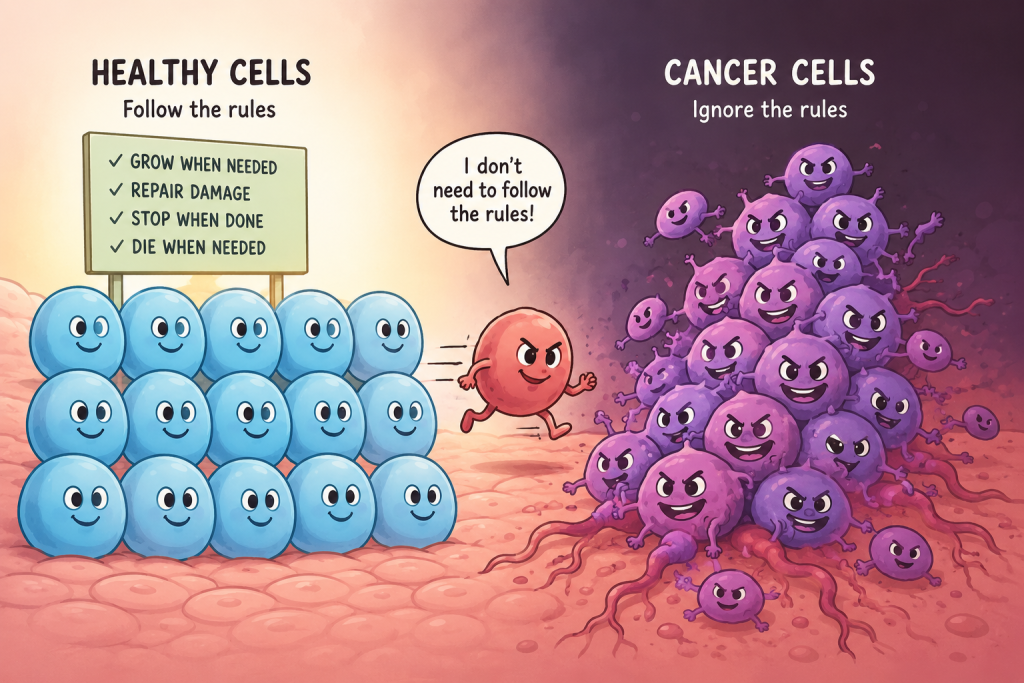
Each cell also follows a surprisingly simple set of rules.
Grow when you’re needed.
Do your job.
Stay where you belong.
When it’s time to stop…
Stop.
Simple.
In fact, your body is replacing old cells every single day. Right now, while you’re reading this, millions of tiny repairs are happening without you lifting a finger.
You could spend the whole afternoon watching football or scrolling through your phone, and your body would still be working overtime.
Now here’s where things become interesting.
Imagine everyone at your office follows company rules.
Then one colleague suddenly decides,
“You know what? I’m doing whatever I like.”
They ignore instructions.
They refuse to stop working.
They start taking over other people’s desks.
Soon enough, they’re causing chaos for everyone else.
That’s surprisingly close to what happens when cancer develops.
A healthy cell acquires changes in its DNA, the instruction manual that tells it how to behave.
Instead of listening to the body’s signals, it keeps growing.
Instead of knowing when to stop, it carries on dividing.
One cell becomes two.
Two become four.
Four become eight.
Over time, those abnormal cells can build up into what we call a tumour.
The strange thing is, these cells aren’t strangers.
They’re your own cells that have forgotten the rules.
I don’t know why, but I find that both fascinating and a little sad.
Here’s the part that completely blew my mind.
Your body is actually dealing with abnormal cells more often than you probably realise.
That’s right.
Your immune system isn’t only busy fighting germs when you catch a cold.
It’s constantly patrolling your body, looking for cells that seem damaged or aren’t behaving normally.
Most of the time, it quietly removes them before you ever know they existed.
No applause.
No announcement.
It just gets on with the job.
Which makes me wonder how many problems our bodies solve every day without us ever saying thank you.
Probably more than we realise.
“But if the immune system is that good,” you might be thinking, “why does cancer still happen?”
That’s the question scientists have been asking for decades.
Sometimes, cancer cells become incredibly good at hiding.
Remember, they started out as normal cells.
That makes them much harder for the immune system to recognise than something obviously foreign, like a virus.
It’s a bit like spotting one person wearing the wrong uniform in a crowd of thousands.
Not impossible.
Just difficult.
The encouraging news is that researchers around the world are learning more about cancer every year.
Some of today’s treatments don’t just attack cancer directly. They also help the immune system recognise and fight it more effectively.
I think that’s one of the most hopeful things about modern medicine.
Of course, we also know there are things that can increase the risk of developing certain cancers, including smoking, excessive alcohol, prolonged exposure to harmful sunlight, some infections, and inherited genetic changes.
But it’s important to remember something.
Risk is not the same as certainty.
Not everyone with a risk factor develops cancer.
And not everyone diagnosed with cancer had obvious risk factors.
Life, and biology, are rarely that simple.
If there’s one thing I’d love you to take away from today’s article, it’s this:
Your body isn’t fragile.
It’s remarkably resilient.
Every single second, trillions of cells are working together to keep you alive.
The fact that this system works as well as it does is nothing short of extraordinary.
Maybe that’s why learning about the human body never gets boring.
The more you discover…
The more impossible it seems.
🧠 Curious Fact of the Week
Every day, your body removes millions of old or damaged cells on purpose and replaces them with new ones.
Scientists call the process apoptosis.
Personally, I think they could have picked a friendlier name.
Either way, it’s one of the reasons your body stays healthy without you even noticing.
Thanks for spending a few minutes with us today.
Stay curious. Your body certainly is.
📬 Enjoying the series?
Subscribe to receive every new article, along with health insights, educational resources, and updates.