
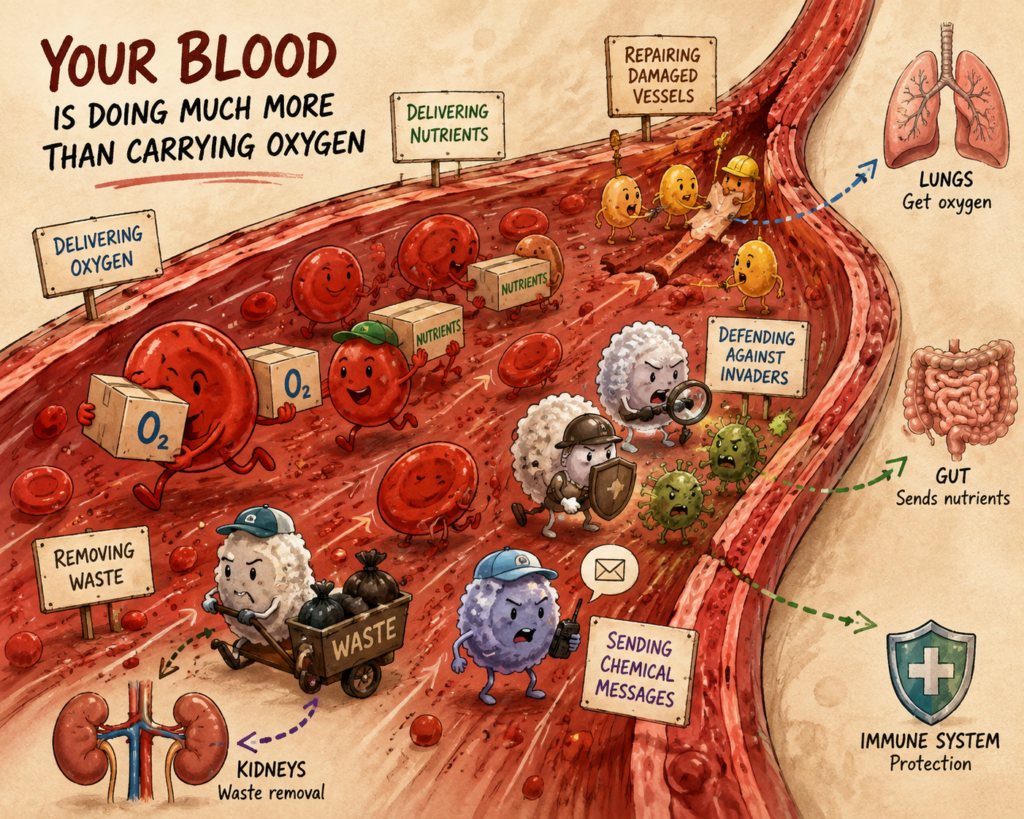
If someone asked you what blood does, you would probably say it carries oxygen around the body.
And that is correct.
But that is only part of what your blood is doing.
In fact, your blood is involved in so many things happening inside your body that it is easy to forget just how much work it is doing while you are simply sitting there reading this.
Let’s start with the obvious one.
Oxygen
When you breathe in, oxygen enters your lungs.
Red blood cells pick up that oxygen and transport it around the body. They do this with the help of a protein called haemoglobin.
The oxygen is eventually delivered to your tissues, where your cells use it to produce the energy they need.
Your brain needs it.
Your muscles need it.
Your heart needs it.
Even the cells in your little toe need oxygen.
So when we say blood carries oxygen, we are talking about something that is happening throughout your body every second.
But blood is doing more than that.
Your blood also carries nutrients
After you eat, your digestive system breaks food down into smaller substances that your body can absorb and use.
Some of those nutrients enter your bloodstream.
Your blood then helps transport them to different parts of the body where they are needed.
So that food you ate earlier does not simply disappear after digestion.
The useful parts of it are broken down, absorbed and then transported to where your body needs them.
Your blood is part of that set up.
Then it takes some waste away
Your cells are constantly working.
And whenever cells are working, waste products are produced.
Blood helps move some of those waste products away from the tissues.
Carbon dioxide, for example, is carried back to the lungs, where you breathe it out.
Other waste products are transported to organs such as the kidneys, which help remove them from the body.
So blood is not only delivering things.
It is also helping to take things away.
And that is something we don’t usually think about.
Your blood is also part of your immune system
This is another part that people often overlook.
Your blood contains white blood cells, which are important parts of your immune system.
These cells help the body recognise and respond to things that may cause harm, including certain bacteria, viruses and other foreign substances.
There are different types of white blood cells, and they do not all do the same thing.
Some help identify threats.
Some attack or destroy harmful organisms.
Some help coordinate the immune response.
Others help the body remember previous encounters so that it can respond more effectively in the future.
And all of this is happening without you having to think about it.
None of us wake up in the morning and remind our immune system to start working.
It is already working.
And then you cut yourself
This is where platelets star.
You cut your finger while preparing food.
There is now a break in a blood vessel and blood is coming out.
The body needs to stop the bleeding.
Platelets move towards the damaged area and help form a plug. Then a series of proteins known as clotting factors help strengthen the developing clot.
It is a very complicated process, but we usually only notice the end result.
The bleeding stops.
You clean the wound and carry on with your day.
Your body has just repaired a small problem without asking you to do very much.
Blood also helps regulate temperature
You may have noticed that your skin becomes red when you are hot, exercising or even embarrassed.
One reason for this is that blood vessels close to the skin can widen, allowing more blood to flow near the surface of the body.
This helps heat move from deeper tissues towards the skin, where it can be released.
When you are cold, blood vessels near the skin can narrow, helping the body reduce heat loss.
So even your body temperature is partly connected to what your blood is doing.
And blood carries messages too
Hormones and other chemical signals can travel through the bloodstream.
A hormone can be produced in one part of the body, enter the blood and then travel to another part where it has an effect.
This is one of the ways different parts of the body communicate with each other.
Lets disect that.
Something is produced somewhere in your body.
It enters your bloodstream.
Your blood carries it somewhere else.
And another part of your body receives the message.
All of this is happening while you are reading this article.
Your blood is carrying oxygen.
It is transporting nutrients.
It is moving waste products.
It is carrying hormones and other chemical signals.
It is supporting your immune system.
It is helping with temperature regulation.
And when you are injured, it helps the body control bleeding and begin the repair process.
So the next time you see a little bit of blood after accidentally cutting your finger, remember that you are looking at something that is more than a red liquid.
It is a living transport system that is constantly moving around your body.
And it has been doing this for you from before you were even born.
That is one of the things I find interesting about the human body.
We spend most of our time looking at ourselves from the outside. We see our hands, our face, our legs and everything else that is visible.
But underneath all of that, there is a lot happening.
And most of the time, we don’t even feelit.
🧠 Curious Fact of the Week
An average adult has roughly 5 litres of blood circulating through the body, although the exact amount varies according to body size and other factors.
The more you learn about it, the more questions you seem to have.
🎓 Explore our programmes:
💬 Speak with our admissions team:
https://wa.me/message/I2HANGAAVNMGI1
🌍 Visit Cyrillic College:
📬 Want more?
The Articles comes out every Friday.
If you enjoy discovering the strange, clever and sometimes surprising things happening inside your own body, you can subscribe here:
Until next Friday…