
If I had one new note of two hundred naira for every time I’ve heard someone say,
“Ah… that’s just dopamine.”
As if, (TINUBUUUUUU!!!!!!)
I’d probably be writing this from an amusement park somewhere.
These days, dopamine gets blamed for almost everything.
Scrolling Insta?
Dopamine.
Watching ten episodes of #Wura?
Dopamine.
Eating that extra slice of cake?
Definitely dopamine.
At this point, dopamine has become social media’s favourite scientific word. People throw it around so confidently that you’d think we all studied neuroscience over the weekend.
The funny thing?
Most of us have no idea what dopamine actually does.
And honestly, that’s not your fault.
For years, dopamine has been introduced as “the happiness chemical.”
Nice.
Simple.
Easy to remember.
There’s just one tiny problem.
It’s not really true.
At least… not in the way most people think.
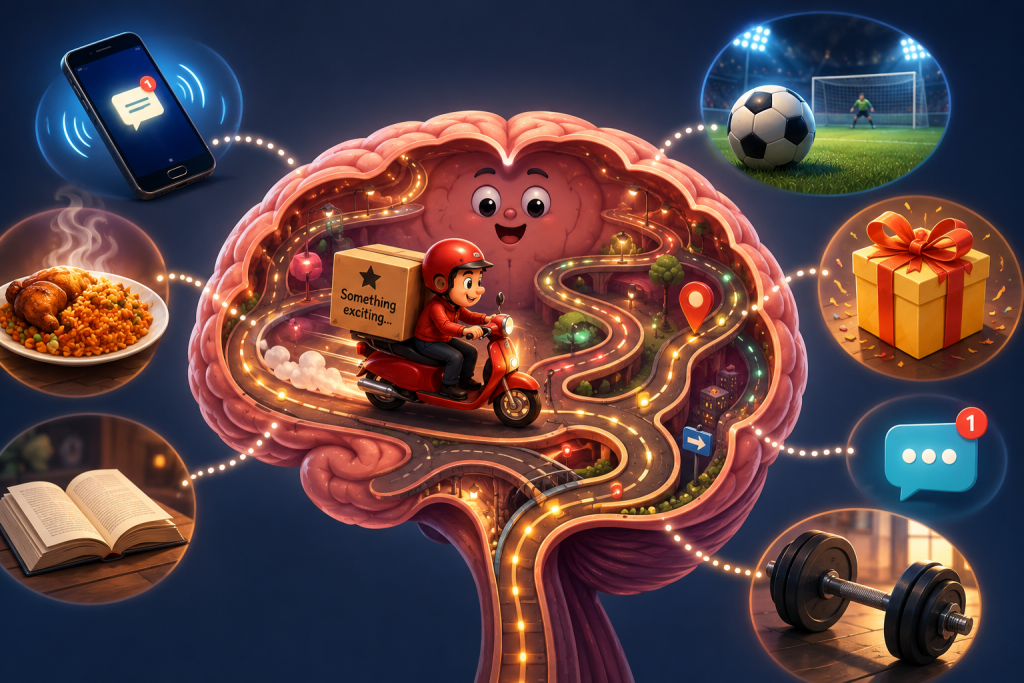
Imagine your friend promises to buy you lunch tomorrow.
The excitement you feel tonight isn’t because you’ve already eaten.
It’s because your brain believes something good is on the way.
That’s dopamine.
It’s less about pleasure and more about anticipation.
It’s your brain saying,
“This looks promising… pay attention.”
That changes everything.
Think about the last time your phone buzzed.
You probably looked almost immediately.
Not because every notification is exciting.
Let’s be honest, half the time it’s Airtel trying to sell you another data plan.
Yet you still check.
Why?
Because your brain has learned that every now and then, a message arrives that matters.
A friend.
A loved one.
Good news.
A meme.
Your brain doesn’t know what’s coming.
It just knows something might be worth seeing.
That’s enough to get your attention.
Congratulations.
You’ve just met dopamine.
Here’s another example.
Have you noticed how buying something you’ve wanted for weeks often feels more exciting before you actually own it?
You spend days comparing prices.
Watching reviews.
Reading comments.
Imagining how great it’ll be.
Then you finally buy it…
…and after a few days, it just becomes another thing you own.
That’s because dopamine is often loudest before the reward arrives.
Your brain enjoys the chase more than you realise.
Actually, this explains something I’ve always found funny.
Remember when Christmas felt like it lasted forever?
Not Christmas Day.
The waiting.
The counting down.
The excitement.
The wondering what was inside those wrapped boxes.
Sometimes I think the anticipation was better than opening the gifts themselves.
Your brain has been doing this since childhood.
Scientists have known for years that dopamine plays a huge role in motivation and learning.
When something unexpectedly goes well, your brain pays attention.
“That worked.”
“Remember that.”
“Let’s try it again.”
It’s one of the reasons you keep practising a skill until you get better.
It’s one of the reasons children learn so quickly.
It’s one of the reasons habits, both good and bad, become habits in the first place.
Which brings us back to social media.
Apps don’t magically “contain dopamine.”
Your brain does.
What many apps are very good at is creating uncertainty.
Maybe the next video will be hilarious.
Maybe the next post will be useful.
Maybe the next notification will make your day.
Maybe.
That tiny word keeps your brain interested.
It’s the same reason people buy gambling tickets.
Refresh their email.
Watch World Cup until the final whistle.
Or keep saying,
“Just one more episode…”
Your brain likes possibilities.
Now, before we start blaming dopamine for every late-night scrolling session, it’s worth remembering something.
Without dopamine, getting out of bed would be much harder.
Learning new skills would feel almost impossible.
Setting goals wouldn’t be nearly as rewarding.
You probably wouldn’t have finished reading this article.
Dopamine isn’t the villain of the story.
It’s one of the reasons human beings stay curious, ambitious and motivated.
The challenge isn’t dopamine.
It’s learning what deserves our attention.
Because whether it’s a new book, a meaningful conversation, learning a skill, exercising, or helping someone else, your brain responds to all of those too.
Maybe the question isn’t,
“How do I avoid dopamine?”
Maybe it’s,
“What kind of life am I training my brain to get excited about?”
I think that’s a much more interesting question.
And probably a more useful one too.
🧠 Curious Fact of the Week
Your brain contains billions of nerve cells, but they don’t touch each other.
Instead, they communicate across tiny microscopic gaps called synapses, using chemical messengers like dopamine.
Your thoughts, memories, emotions and movements all depend on conversations happening across gaps too small to see.
If that isn’t amazing, I don’t know what is.
📬 Enjoyed The Article?
Join our growing community and receive a new edition every Friday, along with health insights, educational resources and updates from Cyrillic College.
Subscribe here: