
I was in a taxi a few weeks ago when a little boy asked his mum a question.
“Mummy… why is the moon following us?”
Then she tried to explain that the moon wasn’t actually following the car.
Before she could finish, another question came.
“So… why does it look like it’s is?”
A few minutes later…
“Why do dogs bark?”
Then…
“Why don’t birds get electrocuted when they sit on electric wires?”
By the time I got to my destination, I realised something.
Ah! Children don’t get tired of asking questions.
But adults get tired of answering them.
Somewhere between childhood and adulthood, something changes.
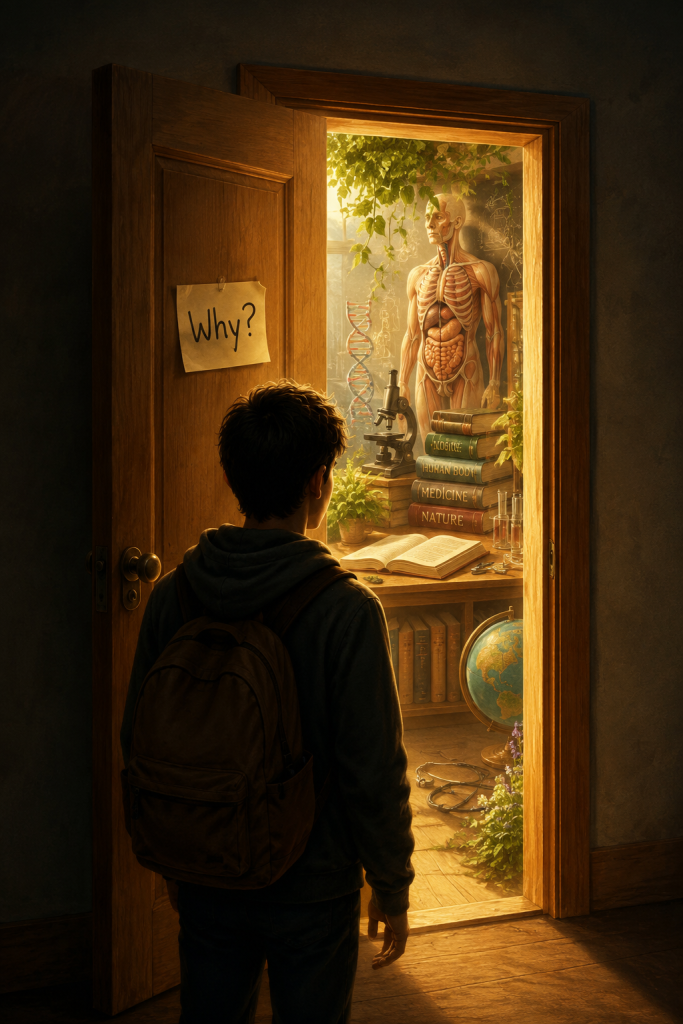
When we’re young, asking “Why?” is almost a full-time job.
Why is the sky blue?
Why do onions make us cry?
Why do we yawn?
Why does ice float?
Why does Grandma have grey hair?
Why is Principal Johnson bald?
Why does aunty Janet go visit brother Samuel on Saturdays? #oops!!
Why is Petrol N1350?
Who is the Director General of PFIPC?
So many questions!!!
Then life happens.
School. Work. Responsibilities. Deadlines. Bills.
Before we know it, we stop asking questions, not because we’ve found all the answers, but because we’ve become too busy to wonder.
And I think that’s a shame.
Because curiosity might be one of the most underrated qualities a person can have.
Think about it.
Every great discovery began with someone refusing to accept, “That’s just how it is.”
Why do people get sick?
Why do some medicines work?
Why do we dream?
Why does the heart never seem to get tired?
Why does one treatment help one patient but not another?
Someone, somewhere, asked those questions for the very first time.
And because they did, the rest of us know more today than we did yesterday.
Curiosity has quietly changed the world.
The funny thing is, it hasn’t disappeared from our lives.
It’s just wearing different clothes now.
You know that moment when you open Google to check one thing…
Then, twenty minutes later, you’ve somehow ended up reading about volcanoes in Iceland or the deepest part of the ocean?
That’s curiosity.
Or when you’re watching football and suddenly wonder why professional athletes never seem to get dizzy after spinning around?
That’s curiosity too.
Maybe you’ve found yourself lying awake wondering why mosquitoes always seem to find you before anyone else.
Or why some people can drink coffee at 10 p.m. and still sleep like babies but when I drink, I cant stop going to toilet?
Those little moments happen every day.
The questions never stopped.
We just stopped paying attention to them.
The truth is, curiosity isn’t about knowing everything.
It’s about enjoying the journey of finding out.
That’s why the most interesting people I’ve met aren’t necessarily the ones with all the answers.
They’re the ones who aren’t afraid to ask another question.
The doctor who still reads new research.
The teacher who keeps learning.
The scientist who says, “I don’t know… let’s find out.”
The grandmother who wants to understand why she is paying me 10k to clear her cache?
The mechanic who wonders how electric cars are changing the future.
They all have one thing in common.
They stayed curious.
And maybe that’s what keeps life interesting.
The human body is probably the greatest example of this.
The more you learn about it, the stranger it becomes.
Your heart will beat over 100,000 times today without asking for permission.
Your brain will send millions of messages while you’re reading this sentence.
Your immune system is quietly protecting you from things you’ll never even know existed.
Your stomach knows how to digest lunch without digesting itself.
Honestly, if someone described the human body to me before I was born, I’d probably think they were making it up.
It’s incredible.
Yet most of us walk around every day carrying this remarkable machine without ever getting to know it.
That’s one of the reasons we publish these articles.
Not because everyone needs to become a healthcare professional. #likeseriously!!
But because everyone deserves to understand the body they live in.
No intimidating medical language.
No lectures.
Just interesting conversations about the most extraordinary thing you’ll ever own: your body.
Who knows?
One answer might lead to another question.
And another.
That’s usually how curiosity works.
And sometimes…
Curiosity doesn’t just change what you know.
It changes where your life goes.
Some people read an article about the human body and move on with their day.
Others discover the secrect about the body they live in
They decide to study further.
They ask deeper questions.
They build careers helping people understand health and improve lives.
Every healthcare professional started with a curios quwstion.
If these Friday conversations have made you realise you still enjoy asking “Why?”, perhaps you’ve discovered something bigger than a new interest.
Perhaps you’ve rediscovered your curiosity.
And that’s always a good place to begin.
🧠 Curious Fact of the Week
A child asks an astonishing number of questions every day.research estimates that young children can ask hundreds of questions in a single day when they’re actively exploring their world.
Maybe growing up isn’t about asking fewer questions.
Maybe it’s about asking better ones.
🎓 Where Curiosity Leads
If you’ve enjoyed reading this article, imagine what it’s like to spend months exploring these questions with experienced lecturers, practical learning, and a community of people who are just as curious as you are.
At Cyrillic College, curiosity is more than a personality trait. It’s the beginning of education.
Whether you’re considering a career in Biomedical Sciences, Integrative Healthcare, Clinical Nutrition, Anatomy, Physiology, Pathology, Microbiology, or one of our other programmes, every journey starts with the same simple question:
“Why?”
Explore our programmes: https://cyrilliccollegehht.com/programmes/
Chat with our admissions team: https://wa.me/message/I2HANGAAVNMGI1
Learn more about Cyrillic College: https://cyrilliccollegehht.com/
📬 Enjoying The Newsletters?
Join our community and receive a new edition every Friday, along with health insights, educational resources, and updates from Cyrillic College.
Subscribe here: