
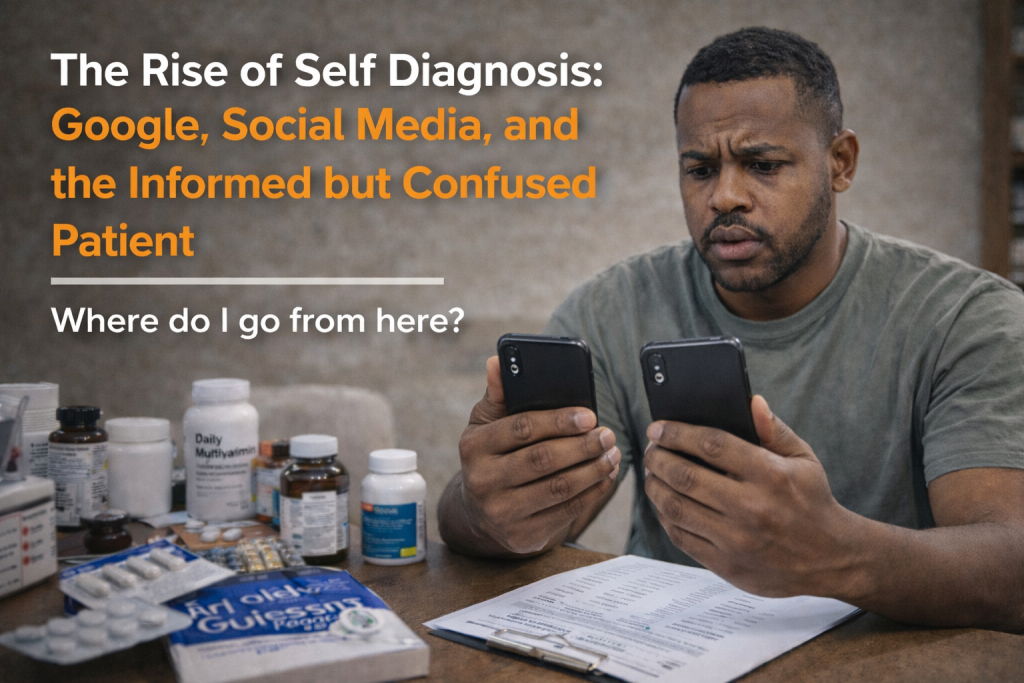
There was a time when patients arrived quietly, described their symptoms, and waited for instruction.
That era is gone.
Today’s patient often arrives with screenshots. Blog articles. Supplement lists saved from Instagram. YouTube lectures. Sometimes even a provisional diagnosis.
“I think it’s adrenal fatigue.”
“I read that this might be candida.”
“A wellness influencer said this is insulin resistance.”
“Google says it could be autoimmune.”
The modern patient is informed. But information is not the same as understanding.
And increasingly, practitioners are facing a new clinical challenge. Not ignorance. But misdirected confidence.
This is the rise of self diagnosis.
Information Is Everywhere. Wisdom Is Not.
Access to medical information has never been easier. Search engines provide millions of results within seconds. Social media platforms reward simplified health narratives. Influencers present confident, persuasive explanations for complex physiology.
But algorithms do not prioritize nuance. They prioritize engagement.
And engagement favors certainty over complexity.
Chronic fatigue becomes adrenal collapse.
Bloating becomes leaky gut.
Headaches become hormonal imbalance.
Low mood becomes serotonin deficiency.
The explanations are attractive because they are simple. They give the patient a sense of control.
Yet human physiology rarely operates in single cause pathways.
The problem is not that patients are researching. Curiosity is healthy. Awareness is powerful.
The problem is that context is missing.
The Supplement Explosion
One of the most visible consequences of self diagnosis is the rapid rise of supplement stacking.
Patients now commonly present with:
Five or more supplements taken simultaneously.
Herbal blends purchased online without dosage clarity.
Imported nutraceuticals without regulatory oversight.
Conflicting recommendations from different online sources.
Some arrive already on magnesium, zinc, ashwagandha, vitamin D, probiotics, iron, liver detox formulas, and sleep aids. All self selected.
Few understand pharmacokinetics.
Few consider drug nutrient interactions.
Few appreciate liver metabolism burden.
In Nigeria especially, where regulatory oversight of imported products can be inconsistent, this presents additional risks.
The intention is often good. The execution is chaotic.
The Psychology of Online Authority
Why do patients trust strangers online?
Because confidence feels like competence.
A well edited video. A charismatic speaker. A persuasive anecdote. A dramatic before and after transformation.
These signals create perceived expertise.
Meanwhile, real clinical reasoning often sounds slower. More cautious. More conditional.
“It depends.”
“We need further evaluation.”
“Let us monitor this.”
“This may be multi factorial.”
To a patient conditioned by algorithm driven certainty, professional nuance can feel less convincing.
This creates tension in consultation rooms.
The Double Edge of Digital Health Literacy
It would be simplistic to condemn online research entirely.
In many ways, digital health literacy has improved patient engagement.
Patients now:
Ask better questions.
Seek second opinions.
Recognize early warning signs.
Demand explanation instead of blind obedience.
This is not a bad evolution.
However, information without interpretive skill leads to anxiety. And anxiety fuels further searching.
The patient moves from website to website. Forum to forum. Influencer to influencer.
Symptoms are reframed repeatedly until something resonates emotionally.
And emotional resonance is often mistaken for diagnostic accuracy.
The Cost of Misinformation
The consequences are not trivial.
Delayed proper diagnosis.
Unnecessary dietary restrictions.
Financial waste on ineffective protocols.
Excessive testing without indication.
Distrust in qualified practitioners.
Some patients oscillate between conventional and alternative systems, never committing to structured care. They become chronically unsettled.
Others abandon evidence based treatment entirely after consuming fear based content online.
The result is fragmented care and prolonged illness trajectories.
What This Means for Practitioners
Self diagnosis is not disappearing.
The question is not how to stop it. The question is how to respond intelligently.
Dismissiveness will not work.
Confrontation rarely works.
Mockery destroys trust.
Instead, practitioners must refine three skills.
First, digital literacy awareness. Understand the ecosystem patients are navigating. Know the common narratives circulating online.
Second, communication maturity. Patients must feel heard before they are corrected.
Third, educational leadership. Instead of simply rejecting misinformation, explain the underlying physiology clearly. Provide reasoning, not authority alone.
The practitioner of 2026 must be clinician and educator simultaneously.
Reclaiming Authority Without Arrogance
Authority in modern healthcare cannot be demanded. It must be demonstrated.
When patients feel respected, they are more open to re evaluation.
Instead of saying, “That influencer is wrong,” say, “Here is how the body actually regulates cortisol.”
Instead of dismissing a supplement, explain hepatic metabolism pathways.
Instead of rejecting a label, broaden the framework.
The goal is not to win arguments. It is to restore coherence.
A Deeper Issue: The Trust Gap
Beneath self diagnosis lies a deeper question.
Do patients feel truly listened to in conventional settings?
Do they feel rushed?
Do they feel reduced to lab values?
Sometimes self diagnosis is not rebellion. It is a search for meaning.
Integrative practitioners are uniquely positioned here.
Longer consultations. Holistic frameworks. Pattern recognition. Lifestyle exploration.
If handled properly, the informed patient can become the most collaborative patient.
The Opportunity
This shift presents opportunity.
Colleges that emphasize rigorous training, clinical reasoning, and communication competence will produce practitioners capable of navigating this era confidently.
Healthcare is not simply changing biologically. It is changing informationally.
The patient of today is curious, digitally exposed, and sometimes overwhelmed.
What they need is not censorship.
They need structured guidance.
They need clarity.
They need practitioners who are grounded enough to absorb the noise and still think clearly.
The Future Consultation
Imagine a consultation where:
The patient presents their research.
The practitioner listens without defensiveness.
Together, they examine evidence.
Together, they build a rational plan.
This is not a loss of authority.
It is a more sophisticated form of care.
The rise of self diagnosis does not signal the collapse of professional medicine.
It signals the need for deeper education, sharper reasoning, and stronger communication.
And that is a challenge worth embracing.