Most people would never ignore a strange noise coming from their car for months.
If the engine starts rattling, attention follows almost immediately. A leaking roof gets repaired before the next rain. A phone battery that suddenly begins dying at 40 percent quickly becomes a problem that needs solving.
Yet many of us do something surprisingly similar with our own health.
A persistent headache becomes normal.
Poor sleep becomes part of life.
Fatigue gets blamed on work.
Stress becomes a personality trait.
A recurring pain is noted, discussed briefly, and then quietly pushed aside.
Not because people do not care about their health. Most people do.
The strange thing is that many health concerns arrive so gradually that they never feel urgent enough to interrupt daily life.
And that is where the trouble begins.
Health rarely competes well against the demands of everyday living.
School fees need to be paid. Deadlines are approaching. Family responsibilities keep multiplying. The generator needs attention. The car needs fuel. There are messages to answer, errands to run, and a hundred other things demanding attention before the day is over.
Against all that noise, a little fatigue does not seem important.
Neither does sleeping five hours a night.
Or skipping breakfast.
Or relying on painkillers more often than usual.
Or putting off that check-up for another six months.
Life keeps moving, so we move with it.
One of the curious things about human nature is that we are remarkably good at dealing with immediate problems and remarkably poor at dealing with distant ones.
A bill due tomorrow creates action.
A meeting in an hour commands attention.
A child with a fever becomes the most important thing in the house.
But a health issue that might become serious in five years? That is easy to postpone.
The human brain has always worked this way.
Psychologists sometimes refer to it as present bias. We naturally give more weight to what is happening right now than what may happen later. The future feels distant, even when it is approaching faster than we realize.
This is why so many people know what they should do but struggle to do it consistently.
They know they need more rest.
They know they should exercise.
They know stress is affecting them.
They know eating habits could improve.
They know they should probably schedule that appointment.
The challenge is not information.
The challenge is urgency.
Without an immediate consequence, the motivation to act often remains weak.
There is another reason people delay paying attention to their health.
Many health problems begin quietly.
The body is rarely dramatic at first.
It whispers.
A little less energy.
A little more tension.
A few more sleepless nights.
A little difficulty concentrating.
An occasional discomfort that appears and disappears.
Nothing dramatic enough to stop life.
Nothing serious enough to demand action.
At least that is what people tell themselves.
The problem is that small changes have a way of becoming normal when they happen gradually.
Think about how quickly people adapt to discomfort.
Someone who once slept eight hours begins sleeping six and eventually accepts constant tiredness as adulthood.
A person under prolonged pressure starts carrying tension in their shoulders so often that they stop noticing it.
Someone experiencing digestive discomfort begins avoiding certain foods without ever asking why the problem exists in the first place.
The body adjusts.
The mind adjusts.
And slowly, the abnormal becomes familiar.
That familiarity can be misleading.
One of the most common phrases people say after receiving a diagnosis is surprisingly simple:
I did not think it was that serious.
Not because they were careless.
Not because they ignored obvious danger.
But because the warning signs often blended into the background of everyday life.
Modern culture does not help much either.
We live in a time that quietly rewards pushing through discomfort.
People admire resilience.
They admire hard work.
They admire productivity.
There is nothing wrong with those qualities.
The difficulty comes when endurance becomes the default response to every signal the body sends.
Feeling exhausted?
Push through.
Not sleeping properly?
Manage somehow.
Constant headaches?
Take something and keep moving.
Stressed?
That is just life.
Over time, people become experts at functioning while unwell.
And because they can still work, still drive, still attend meetings, still take care of others, they assume everything is fine.
Until something forces attention.
A hospital visit.
A diagnosis.
A health scare.
A moment that suddenly turns a future concern into a present reality.
Then all the things that felt unimportant become impossible to ignore.
Ironically, health is often most appreciated when it is interrupted.
People rarely wake up feeling grateful that their joints move without pain.
Few people celebrate a normal night’s sleep.
Most do not spend much time appreciating a healthy digestive system, stable energy, or the simple ability to go through a day without discomfort.
Those things tend to remain invisible until they are lost.
Perhaps that is the strangest part of all.
Good health is so valuable, yet it is often treated as something that will always be there.
Until one day it is not.
This does not mean people should become anxious about every ache, pain, or unusual sensation. Life would be exhausting if every headache became a cause for alarm.
But it does mean there is wisdom in paying attention.
The body has ways of communicating long before problems become crises.
Sometimes the signals are subtle.
Sometimes they are easy to dismiss.
Yet they are often worth listening to.
Because health is not simply about responding when something goes wrong.
It is also about noticing what is happening while things still seem right.
That growing appreciation for prevention, observation, and a deeper understanding of health is one reason more people are exploring broader approaches to healthcare and wellbeing.
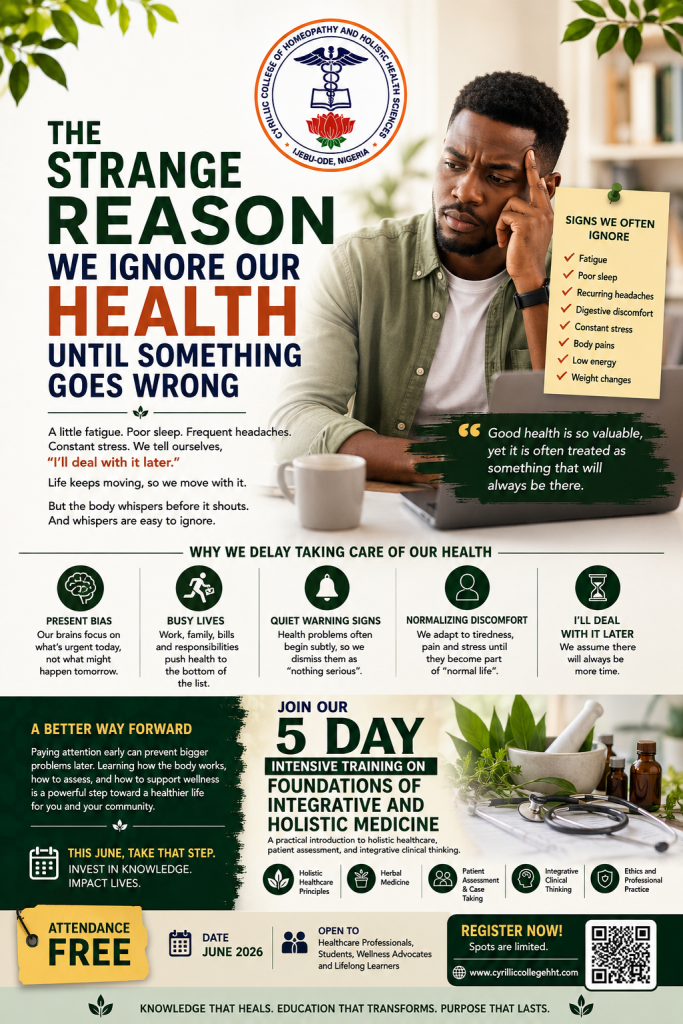
This June, Cyrillic College of Homeopathy and Holistic Health Sciences will host a 5 Day Intensive Training on Foundations of Integrative and Holistic Medicine.
The workshop will introduce participants to holistic healthcare principles, patient assessment, clinical thinking, and integrative approaches to health and wellness.
Attendance is free.
For some people, learning begins after a major health event.
For others, it begins with curiosity.
Registration link: https://docs.google.com/forms/d/e/1FAIpQLSfDKIHIlPeSdn3d-RUBrVTqky5U5RZelhSZ_lSUEGBSYKUYrQ/viewform?usp=header