
Have you ever wondered why your blood group is different from someone else’s?
You may be O positive.
Someone else may be A positive.
Another person may be B negative, while another person is AB positive.
But if we all have blood flowing through our bodies, why are there different blood groups in the first place?
The answer has a lot to do with genetics and the immune system.
Let us start from the beginning.
Your blood is not just a red liquid flowing around your body. It contains red blood cells, white blood cells, platelets and plasma, and each of these has an important job to do.
The red blood cells are especially important when we talk about blood groups.
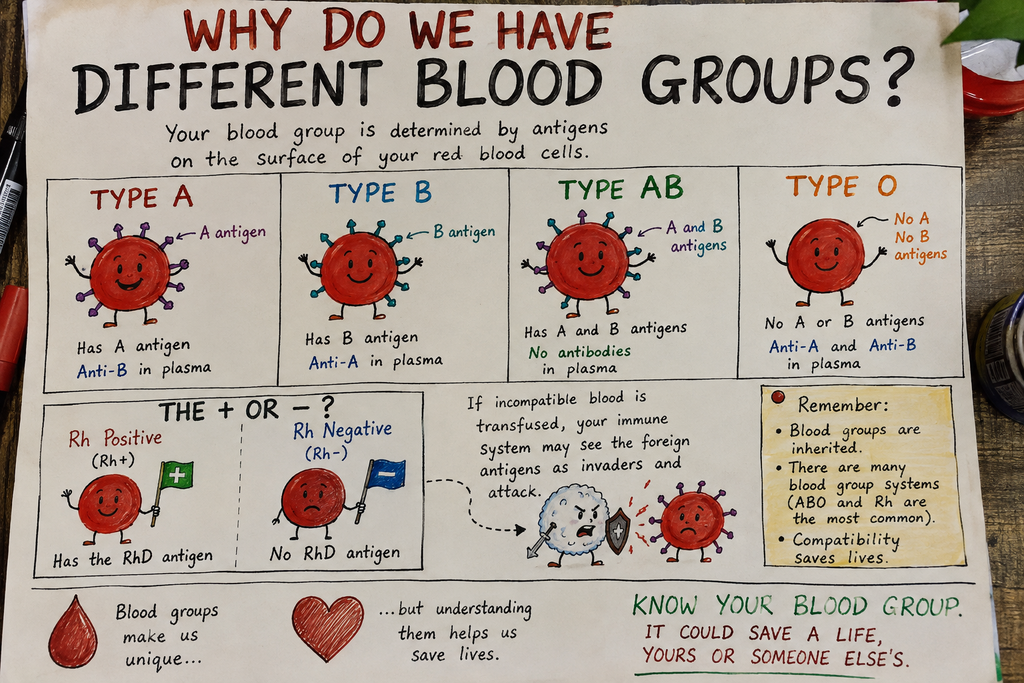
On the surface of these red blood cells are tiny structures called antigens. You can think of them as little identification markers.
Some people have A antigens.
Some have B antigens.
Some have both A and B.
And some have neither.
This is where the ABO blood groups come from.
If you have A antigens, your blood group is A.
If you have B antigens, you are B.
If you have both, you are AB.
And if you have neither A nor B, you are O.
Now, you may be wondering, why should these tiny markers matter?
This is where the immune system comes in.
Our immune system is constantly checking the body. It is able to recognise what belongs to us and what does not.
People naturally have antibodies against the ABO antigens that are not present on their own red blood cells.
So, a person with blood group A has A antigens on their red blood cells, but their plasma contains antibodies that can react against B antigens.
This is one of the reasons blood transfusion cannot be treated casually.
You cannot simply take blood from one person and give it to another person without checking compatibility.
If the wrong blood group is given, the immune system can recognise the donated red blood cells as foreign and attack them. This can cause a serious transfusion reaction.
And then there is the familiar positive or negative sign.
This is called the Rh factor, another blood group system.
If you have the RhD antigen, you are Rh positive.
If you do not have it, you are Rh negative.
So, when someone tells you they are O positive or A negative, they are not simply giving you a medical label. They are describing some of the characteristics found on the surface of their red blood cells.
But why did humans develop different blood groups?
This is where genetics comes into the picture.
We inherit our blood group genes from our parents. Over many generations, different blood group traits have been passed through human populations.
Scientists also study the relationship between blood groups and certain diseases. Some blood groups have been associated with a higher or lower risk of particular conditions, although having a particular blood group does not mean that you will develop a particular disease.
So the next time you see your blood group written as O+, A-, B+ or AB+, remember that there is much more behind those letters and signs than you may think.
Your blood group is part of your genetic identity.
And once again, the human body gives us another reason to ask a very simple question:
Why?
🧠 Curious Fact of the Week
The ABO blood group system was described by Austrian scientist Karl Landsteiner in the early 20th century. His work helped explain why some blood transfusions were successful while others caused dangerous reactions.
He was awarded the Nobel Prize in Physiology or Medicine in 1930 for his discoveries concerning human blood groups.
One discovery changed how we understand something that most of us simply call:
“My blood type.”
🎓 If You Studied This…
A simple question like “What’s your blood group?” opens the door to genetics, immunology, physiology, haematology and biochemistry.
You can start with something as ordinary as knowing whether you’re O+ or A-, and suddenly you’re looking at the human body in an entirely different way.
If you’re curious about where that kind of learning can take you, explore the programmes at Cyrillic College.
🎓 Explore our programmes:
https://cyrilliccollegehht.com/programmes/
💬 Speak with our admissions team:
https://wa.me/message/I2HANGAAVNMGI1
🌍 Visit Cyrillic College:
https://cyrilliccollegehht.com/
📬 Want more?
These articles come out every Friday, bringing you fascinating questions about the human body, health and the science behind both, explained without the headache.
Subscribe here:
Until next Friday…
Stay curious.