
Last week, I spent almost ten minutes looking for my glasses.
I checked the living room.
The kitchen.
My bedroom.
Even the fridge.
Don’t ask.
Eventually, my neighbour looked at me, laughed, and said,
“Oga… they’re on your head.”
Now, before you judge me too quickly, you’ve probably done something similar.
You’ve searched everywhere for your phone while holding it in your hand.
You’ve walked into a room and completely forgotten why you went there.
You’ve greeted someone confidently… only to realise two seconds later that you’ve mistaken them for someone else.
Moments like these make us joke that our brains are “not working.”
But here’s the funny part.
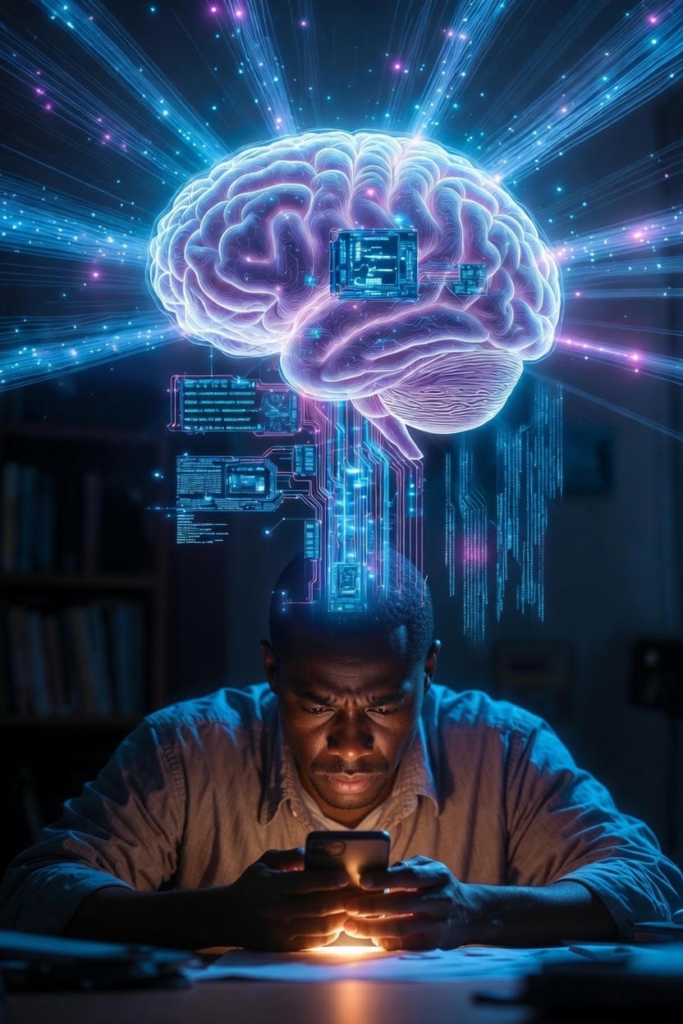
Even while you’re forgetting where you left your keys, your brain is doing things that the most powerful computers on Earth still struggle to do.
Seriously.
Take faces, for example.
Imagine you’re at a wedding.
Music is playing.
Children are running around.
People are talking over one another.
Then, in the middle of all that, you spot your secondary school classmate whom you haven’t seen in fifteen years.
You recognise them almost instantly.
No loading screen.
No facial recognition software.
No internet connection.
Your brain just… knows.
Scientists are still trying to build computers that can recognise faces as naturally and effortlessly as we do.
Your brain has been doing it for free since childhood.
That’s your first superpower.
Here’s another one.
Have you ever caught a ball without really thinking about it?
Someone throws it towards you.
Your eyes follow it.
Your hands move.
You catch it.
Simple.
Except it isn’t.
In those few seconds, your brain calculated the ball’s speed, direction and where it would land. It coordinated your muscles, adjusted your balance and timed your movements with incredible precision.
And it all happened before you had time to think,
“I should probably catch that.”
Not bad for something sitting quietly inside your head.
Then there’s your heartbeat.
Take a moment.
Don’t check your pulse.
Don’t place your hand on your chest.
Just continue reading.
Your heart is still beating.
Your lungs are still breathing.
Your eyes are blinking.
Your blood pressure is constantly being adjusted.
Your body temperature is being kept within a safe range.
Your brain is managing all of that without asking for your attention.
Imagine if you had to remember to breathe every thirty seconds.
None of us would make it through a good night’s sleep.
Sometimes, I think the biggest reason we don’t appreciate the brain is because it never sends us an invoice.
It quietly works every second of every day without demanding applause.
Here’s the part that amazes me most.
Your brain is made up of around 86 billion nerve cells, called neurons.
Each one can communicate with thousands of others, creating a communication network so vast that scientists are still uncovering how it all works.
Every memory you’ve ever made.
Every song you know by heart.
Every face you’ve recognised.
Every language you’ve learned.
Every laugh.
Every tear.
Every dream.
It all began with tiny electrical and chemical messages travelling between those neurons.
And somehow, those billions of conversations become… you.
Your personality.
Your favourite food.
Your sense of humour.
Your memories of home.
If that doesn’t make you pause for a second, I don’t know what will.
Of course, your brain isn’t perfect.
It gets tired.
It gets distracted.
It forgets things.
Sometimes it jumps to conclusions.
Sometimes it convinces you that you’ve locked the front door… even after you’ve checked it three times.
But perhaps that’s what makes it so fascinating.
It’s incredibly powerful, yet wonderfully human.
The next time you forget where you left your keys, don’t be too hard on yourself.
Your brain may have misplaced your car keys, but at that exact moment it was also recognising voices, controlling your breathing, keeping your balance, storing memories, regulating your heartbeat and helping you understand every word you’re reading.
I’d say that’s a pretty fair trade.
 Curious Fact of the Week
Your brain weighs only about 1.3 to 1.4 kilograms, roughly 2% of your body weight.
Yet it uses about 20% of the energy your body produces.
That’s a lot of fuel for something that fits comfortably inside your head.
No wonder thinking can be so tiring.
 Where Curiosity Leads
If today’s article made you stop and think,
“I wish I understood the human body better,”
that’s exactly where education begins.
At Cyrillic College, curiosity is more than a personality trait. It’s the starting point for understanding health, disease and the remarkable systems that keep us alive.
Whether you’re taking your first step into healthcare or you’re already a practitioner looking to deepen your knowledge, there’s a programme designed to help you grow.
 Explore our programmes:
 Chat with our admissions team:
 Learn more about Cyrillic College: