Ebola is in the news again, and naturally, people have questions. What exactly is Ebola? How does it spread? What should we look out for? And what can we do to protect ourselves?
These are important questions, and we think it is worth taking a moment to talk about them. Not to create panic, and certainly not to give anyone a reason to stigmatise others, but to help us understand what we are dealing with and how to respond.
So, what has happened?
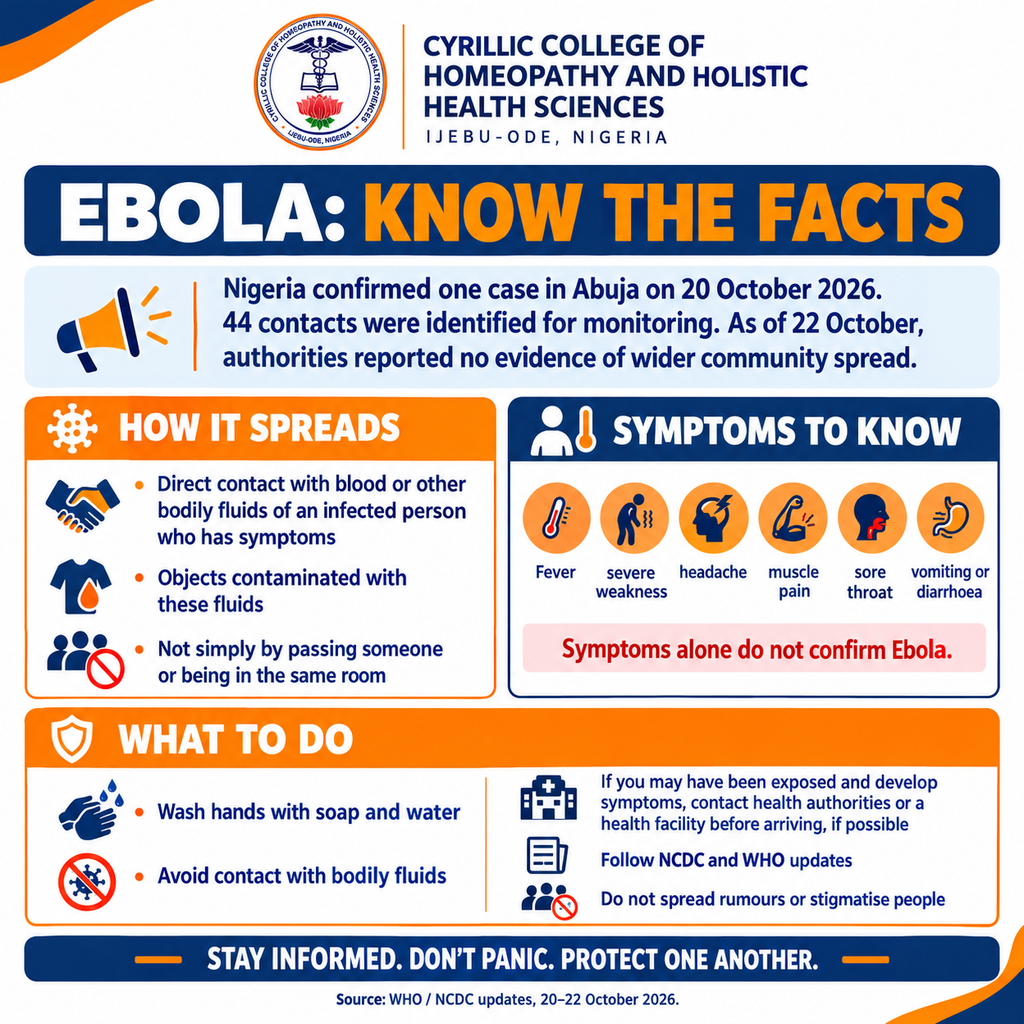
On 20 October 2026, Nigeria confirmed a case of Ebola disease in Abuja. The woman who tested positive had recently travelled through Uganda, and health authorities identified 44 people who had been in contact with her for monitoring.
Investigations are ongoing to establish where she became infected. The important thing for us to understand is that a confirmed case calls for a serious public health response, but it does not automatically mean that the virus is spreading widely in our communities.
This is why health authorities work to identify contacts, monitor their health and respond quickly if anyone develops symptoms. The earlier a case is identified, the better the chances of preventing further transmission.
How does Ebola spread?
Ebola is a viral disease that can cause severe illness. It spreads primarily through direct contact with the blood or other bodily fluids of someone who is sick with the disease or has died from it. It can also spread through objects contaminated with these fluids.
This means that caring for an infected person without proper protective measures can put someone at risk. Contact with contaminated clothing, bedding or medical equipment can also be dangerous.
But here is something worth understanding: Ebola does not spread simply because you sit beside someone, walk past them or share the same space without exposure to infectious bodily fluids. People are generally not infectious before symptoms begin.
Understanding this helps us take the right precautions without becoming unnecessarily afraid of one another.
What happens when someone gets Ebola?
Symptoms usually appear between 2 and 21 days after infection. They may begin with fever, headache, muscle pain, unusual weakness and sore throat. Other symptoms can include vomiting, diarrhoea, abdominal pain and rash. Bleeding can occur, but it does not happen in every case.
The challenge is that some of these symptoms are similar to those of other illnesses we are familiar with, including malaria. A fever or headache alone does not mean someone has Ebola.
However, if someone develops compatible symptoms after a possible exposure, they should seek urgent medical guidance and explain the possible exposure. Where possible, they should contact a health facility or public health authority before arriving so that appropriate precautions can be arranged.
Testing is necessary to confirm the diagnosis. We should not try to diagnose Ebola ourselves.
Is Ebola treatable?
This is an important question because there is a lot of fear surrounding the disease.
Ebola can be fatal, but a diagnosis does not automatically mean someone will die. Early medical care, careful monitoring, rehydration and treatment of complications can improve a patient’s chances of survival.
There is also an important detail about the current outbreak. The virus confirmed in Nigeria is the Bundibugyo virus, a species of Ebola virus for which there is currently no approved specific treatment or licensed vaccine. This makes early detection, appropriate medical care and preventing further transmission especially important.
Anyone who may have been exposed should not wait for severe symptoms before seeking advice.
What can we do to protect ourselves?
We do not need to panic, but we do need to be sensible.
Wash your hands regularly with soap and water. Avoid contact with the blood and bodily fluids of anyone who may be infected. Do not handle the body of someone suspected or confirmed to have died from Ebola, and do not attempt to care for a suspected case without appropriate guidance and protective equipment.
If you believe you have been exposed, contact the appropriate health authorities for advice and follow their instructions. Do not attempt to manage a suspected case at home.
And please, be careful about what you share. Before forwarding that WhatsApp message or alarming voice note, check whether the information comes from a reliable source. The Nigeria Centre for Disease Control and Prevention (NCDC), the Federal Ministry of Health and Social Welfare, and the World Health Organization (WHO) are useful places to look for verified updates.
Let us talk about stigma, too
When an infectious disease makes the news, fear can quickly turn into suspicion. People may begin to avoid anyone who has travelled, anyone who develops a fever or anyone who is being monitored by health authorities.
But someone identified as a contact is not necessarily infected. Contact tracing is simply a way of identifying people who may have been exposed and monitoring them.
People who become ill need medical attention, not blame. Stigmatising patients, their families or people from particular countries can discourage others from reporting symptoms or seeking help.
We can take Ebola seriously without treating people unfairly.
At a time like this, what we need is accurate information, sensible precautions and a willingness to cooperate with health professionals.
Let us stay informed, pay attention to official updates and look out for one another. Awareness is not about creating fear. It is about knowing enough to make responsible decisions and protect our communities.
🧠 Curious Fact of the Week
One can be infected with Ebola without showing symptoms immediately.
Ebola symptoms can take 2 to 21 days to appear after infection. People with Ebola are generally not infectious before symptoms begin, which is one reason health authorities monitor contacts for 21 days.
For further information and official updates: Please consult the World Health Organization (WHO) – Ebola Disease Fact Sheet and the Nigeria Centre for Disease Control and Prevention (NCDC).
 Explore our programmes:
https://cyrilliccollegehht.com/programmes/
 Speak with our admissions team:
https://wa.me/message/I2HANGAAVNMGI1
 Visit Cyrillic College:
https://cyrilliccollegehht.com/
 Want more?
These articles come out every Friday, bringing you fascinating questions about the human body, health and the science behind both, explained without the headache.
Subscribe here:
Until next Friday…
Stay curious.