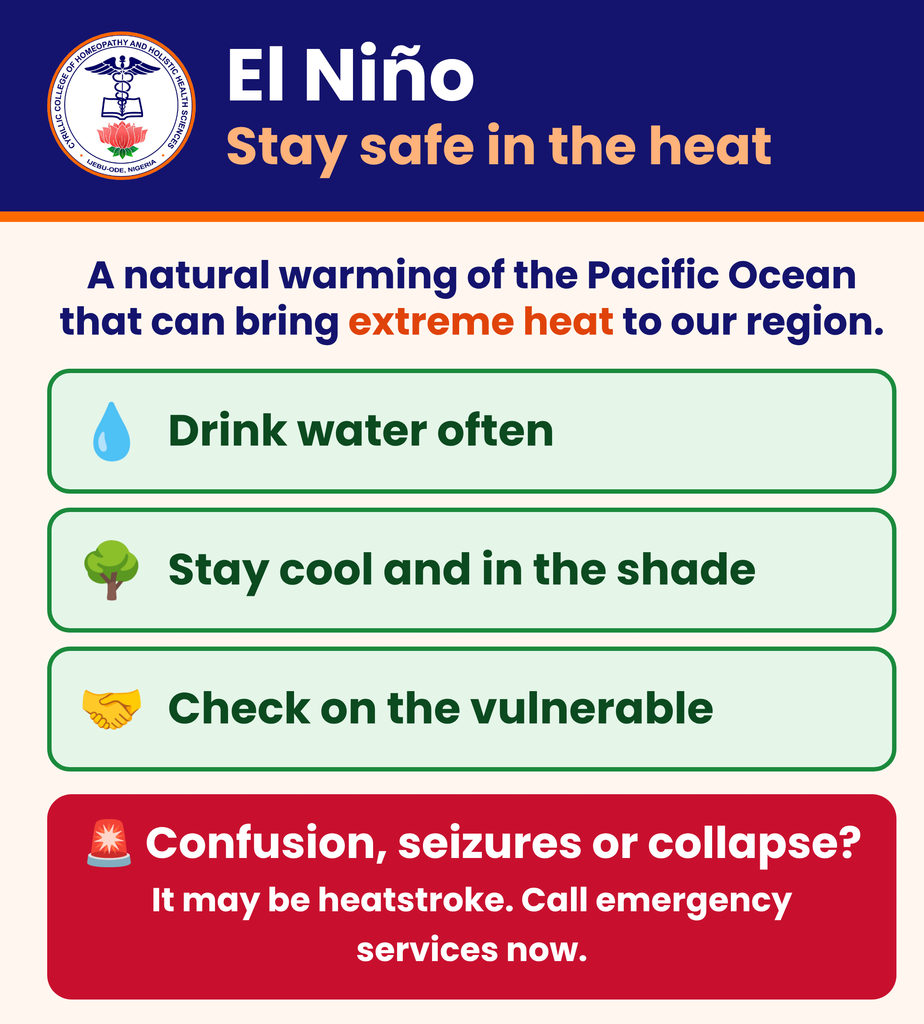
There has been a lot of conversation about El Niño recently, particularly with reports of unusually high temperatures and the possibility of extreme heat in the coming months. Some of the reports are quite alarming, and people are beginning to ask questions. What exactly is El Niño? Why is everyone talking about a Super El Niño? What happened during previous El Niño events? And what does all of this mean for our health? These are questions worth discussing, especially for those of us in healthcare. Many people may not know that prolonged exposure to excessive heat can cause serious health problems. Some of the symptoms people experience during very hot weather may appear ordinary at first, but they can become dangerous if not recognised and managed early.
So, let’s understand what is happening, what we should look out for and what we can do about it.
El Niño is a natural climate phenomenon that begins in the Pacific Ocean. It happens when the surface waters of the central and eastern tropical Pacific become warmer than usual. This warming affects the movement of air and moisture around the world, which can change rainfall and temperature patterns in different countries. Now, you may be wondering what the Pacific Ocean has to do with us here in Nigeria. Quite a lot, actually. Changes in ocean temperatures can influence weather patterns thousands of kilometres away. Depending on the region, this can mean unusually high temperatures, reduced rainfall, drought or even increased rainfall and flooding.
It is important to understand that El Niño is not itself a heatwave. A heatwave is a prolonged period of unusually high temperatures in a particular location. El Niño can contribute to conditions that make extreme heat more likely in some parts of the world.
Not all El Niño events are equally strong. Some are relatively weak, while others are much more intense. When an event is exceptionally strong, it is commonly described as a Super El Niño. This is an informal description rather than a separate scientific classification. The current El Niño has been strengthening, and forecasts from the World Meteorological Organization and NOAA indicate that it could become one of the strongest events recorded, with significant effects on global weather patterns into early 2027.
There is also a historical reason for the concern. Between 1876 and 1878, the world experienced what is known as the Great Drought and Global Famine. Severe drought affected several parts of Asia, Africa and South America, contributing to widespread crop failures and famine. Research estimates that more than 50 million people died during this period. The 1877–78 El Niño was one of the strongest recorded, but it was not the only factor responsible for the disaster. Other climate conditions, food shortages, poverty and social circumstances contributed to the devastating loss of life.
Why are we mentioning this? Because El Niño is not simply about changes in temperature. Its effects can extend to food production, water availability, agriculture and public health.
Our bodies have a natural way of regulating temperature. When we become hot, we sweat. As the sweat evaporates, it helps cool the body. But when temperatures remain very high, particularly when humidity is also high, the body may struggle to release heat effectively. We also lose more water and salts through sweating. The heart has to work harder, and prolonged exposure can put considerable strain on different organs.
Some of the conditions that can develop include:
Dehydration: This happens when the body loses more water than it takes in. Patients may complain of thirst, dry mouth, headaches, dizziness, tiredness and reduced urination.
Heat cramps: These are painful muscle spasms that may occur during or after physical activity in hot conditions, often associated with excessive sweating and loss of salts.
Heat exhaustion: This occurs when the body becomes overheated and struggles to cope. Symptoms include heavy sweating, weakness, headache, dizziness, nausea, vomiting and a rapid heartbeat.
Heatstroke: This is the most serious heat-related illness. It occurs when the body’s temperature regulation fails, potentially causing damage to the brain, kidneys, heart and other organs. Warning signs include confusion, unusual behaviour, seizures and loss of consciousness. It is a medical emergency.
There are also concerns about worsening cardiovascular, respiratory and kidney conditions, particularly among people who already have underlying health problems. This is why we need to pay attention to what our patients are experiencing during periods of excessive heat. Although anyone can develop heat-related illness, some people are more vulnerable. These include infants and young children, older adults, pregnant women, people living with chronic illnesses and those taking medications that may affect sweating or fluid balance.
Outdoor workers, farmers, construction workers and people who spend long hours under direct sunlight are also at increased risk. As practitioners, these are some of the people we should be paying particular attention to.
There are practical things we can do, and they are not particularly complicated.
- Drink water regularly. Do not wait until you are very thirsty.
- Avoid strenuous outdoor activities during the hottest periods of the day.
- Wear light, loose-fitting clothing.
- Stay in shaded or cooler environments whenever possible.
- Take cool showers or use damp towels to cool the body.
- Avoid spending long periods in poorly ventilated, overcrowded spaces.
- Check on older people, children and people living with chronic illnesses.
- Follow local weather advisories and heat warnings.
These precautions are particularly important for people who work outdoors or cannot easily access cooler environments.
If someone is experiencing heat exhaustion, move them to a cooler place, allow them to rest, loosen unnecessary clothing and cool their skin with cool water or damp towels. If they are fully conscious and able to swallow safely, offer cool drinking water. Monitor them and seek medical attention if they do not improve or their condition worsens.
Heatstroke is different. It is an emergency, and we should not attempt to manage it at home. Call emergency medical services immediately. Move the person away from the heat and begin rapid cooling using cold water, wet towels, ice packs and fanning where available. Continue cooling while waiting for medical assistance. Do not give an unconscious or confused person anything to drink.
Do not use paracetamol or ibuprofen to treat heatstroke. These medicines do not correct the dangerous rise in body temperature.
This is an opportunity for practitioners to become more involved in public health education. We should be able to recognise when a patient may be experiencing dehydration or heat-related illness. A patient complaining of persistent headaches, dizziness, unusual weakness, muscle cramps or nausea may need to be assessed for possible heat exposure, especially during periods of extreme temperatures. We can also educate our patients about hydration, nutrition, appropriate rest and avoiding excessive heat exposure. We can organise awareness sessions, share reliable information and encourage families to check on vulnerable members.
Most importantly, practitioners should know when a condition requires urgent medical attention. Heatstroke, for example, is not something to manage with routine complementary therapies. It requires emergency medical care. The healthcare system needs contributions from different healthcare professionals. As the demands on healthcare continue to grow, complementary and integrative practitioners also have an opportunity to strengthen their contribution to community health and public health education.
We do not need to wait until people begin presenting with heat exhaustion or heatstroke before we start talking about prevention. Our patients need to understand what excessive heat can do to the body and what they can do to protect themselves. El Niño is a natural climate phenomenon, but its effects can be serious. We should pay attention to official weather forecasts, understand the health risks and take sensible precautions. Let’s use this opportunity to educate our communities, particularly those who may be more vulnerable to extreme heat. The more people understand what to do, the better equipped they will be to protect their health.
🧠 CURIOSITY FACT OF THE WEEK
Did you know that “Super El Niño” is not actually a separate scientific classification?
It is an informal term used to describe an exceptionally strong El Niño event. The phenomenon itself is driven by unusually warm surface waters in the central and eastern tropical Pacific Ocean, but its influence can extend thousands of kilometres away, affecting rainfall, temperatures and weather patterns across the world.
One ocean phenomenon. Effects felt across continents!
CLICK ON THE FOLLOWING LINKS FOR MORE INFORMATION
- World Meteorological Organization (WMO): El Niño set to become very strong, raising risks of extreme weather into 2027. World Meteorological Organization+1
- NOAA: El Niño/Southern Oscillation Diagnostic Discussion. Climate Prediction Center
- NiMet: August 2026 Seasonal Climate Prediction Update. NiMet
- WHO: Climate Change, Heat and Health. World Health Organization
- WHO: What to Do If You See Signs of Heatstroke. World Health Organization
- Historical research: Climate and the Global Famine of 1876–78. DOI
 Explore our programmes:
https://cyrilliccollegehht.com/programmes/
 Speak with our admissions team:
https://wa.me/message/I2HANGAAVNMGI1
 Visit Cyrillic College:
https://cyrilliccollegehht.com/
 Want more?
These articles come out every Friday, bringing you fascinating questions about the human body, health and the science behind both, explained without the headache.
Subscribe here:
Until next Friday…
Stay curious.