
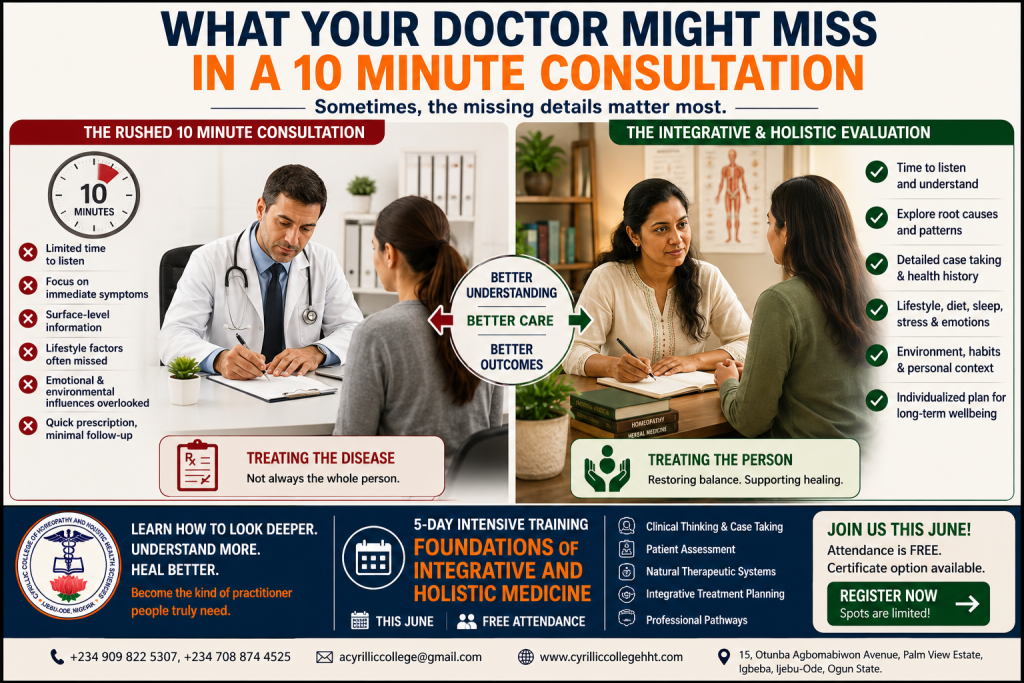
Modern healthcare moves fast.
In many clinics and hospitals today, healthcare professionals work under enormous pressure. Long patient queues, administrative responsibilities, limited staffing, and growing healthcare demands often leave very little time for detailed consultations.
As a result, many patient appointments last only a few minutes.
In that short window, practitioners must gather symptoms, review medical history, make clinical decisions, prescribe treatment, document findings, and prepare for the next patient.
This system has helped healthcare providers manage large patient populations efficiently. In emergency situations and acute illness, speed can be essential.
But when it comes to long-term health and chronic conditions, an important question arises:
What important details might be overlooked when there is very little time to fully understand the patient?
This question lies at the heart of why many people are becoming interested in integrative and holistic healthcare approaches.
Symptoms Are Only Part of the Story
A symptom rarely exists in isolation.
Headaches, digestive problems, fatigue, skin conditions, insomnia, anxiety, and chronic pain can all be influenced by multiple factors interacting within the body.
Yet in a brief consultation, the focus often has to remain on the most immediate complaint.
For example, a patient may report recurring fatigue. Medication or supplements may help temporarily, but the deeper influences contributing to that fatigue may remain unexplored.
Could stress be affecting sleep quality?
Could nutritional deficiencies be playing a role?
Could chronic inflammation, emotional strain, hormonal imbalance, or lifestyle patterns be contributing factors?
These questions require time, detailed observation, and careful patient evaluation.
The Importance of Listening to the Patient’s Full Story
One of the defining features of integrative healthcare is the belief that understanding the patient’s story is essential to understanding the illness itself.
Holistic practitioners often spend considerable time exploring areas such as:
Lifestyle habits
Dietary patterns
Sleep quality
Stress levels
Emotional wellbeing
Environmental exposures
Past medical history
Daily routines and work conditions
This process is commonly known as case taking.
The goal is not simply to identify symptoms, but to understand the broader patterns affecting the patient’s health.
In many cases, these patterns reveal connections that might otherwise go unnoticed.
Chronic Illness Is Often Complex
Many chronic health conditions develop gradually over time.
Unlike acute infections or injuries, chronic illnesses often involve a combination of factors interacting over months or years.
For example:
Persistent digestive issues may involve diet, stress, gut health, and lifestyle patterns.
Recurring headaches may relate to sleep quality, emotional tension, dehydration, posture, or hormonal influences.
Chronic fatigue may involve nutritional imbalance, stress overload, sleep disruption, or underlying inflammation.
If only the surface symptoms are addressed while deeper influences remain unchanged, the condition may continue to return.
This is one reason many patients feel frustrated when symptoms improve temporarily but never fully resolve.
Looking Beyond the Diagnosis
A diagnosis is important, but it is not always the complete picture.
Two individuals may share the same diagnosis while having completely different contributing factors behind their condition.
For example, two patients diagnosed with anxiety may have very different experiences:
One may be dealing primarily with chronic stress and burnout.
Another may have nutritional deficiencies, hormonal imbalance, or unresolved trauma contributing to symptoms.
Integrative healthcare recognizes this individuality and aims to tailor care accordingly.
Rather than treating all patients identically, practitioners attempt to understand the unique circumstances shaping each person’s health.
The Human Side of Healthcare
Another reason many people are drawn to holistic approaches is the experience of being truly heard.
Patients often describe feeling rushed during short consultations. Important details may be forgotten, emotional concerns may remain unspoken, and the patient may leave with unanswered questions.
Integrative practitioners often emphasize patient-practitioner communication as an important part of the healing process.
By creating space for detailed conversation, practitioners can better understand not only the illness but also the patient’s lived experience.
This more human-centered approach can help build trust, clarity, and long-term health strategies.
Integrative Healthcare Is About Broader Understanding
It is important to understand that integrative medicine is not about rejecting conventional healthcare.
Modern medicine remains essential for emergency care, surgery, advanced diagnostics, infectious disease management, and many other areas.
Integrative healthcare instead seeks to expand the conversation around health by incorporating additional perspectives on lifestyle, prevention, individualized care, and long-term wellbeing.
This broader approach often includes:
Nutritional support
Lifestyle medicine
Stress management
Natural therapeutic systems such as homeopathy and herbal medicine
Preventive healthcare strategies
The goal is to support the body’s ability to maintain balance while addressing the many factors that influence health.
Learning the Art of Patient Assessment
Understanding how practitioners gather information, analyze health patterns, and develop individualized strategies requires proper training.
Case taking and patient evaluation are foundational skills within integrative healthcare.
Practitioners must learn how to:
Observe subtle patterns
Ask meaningful questions
Understand symptom relationships
Analyze lifestyle influences
Develop personalized treatment approaches
These skills are developed through education, guided practice, and clinical experience.
Upcoming Training Opportunity
This June, Cyrillic College of Homeopathy and Holistic Health Sciences will host a 5 Day Intensive Training on the Foundations of Integrative and Holistic Medicine.
The training is designed to introduce participants to:
The philosophy of holistic healthcare
Clinical thinking and patient assessment
Case taking and individualized evaluation
Natural therapeutic systems
Integrative treatment planning
Professional pathways in holistic healthcare
Participants will learn from experienced practitioners actively working in the field.
Attendance is free, and participants who wish to obtain certification will have the option to do so upon completion.
For anyone interested in understanding how integrative practitioners approach patient care beyond the limitations of brief consultations, this workshop provides an excellent opportunity to explore these concepts in greater depth.
Healthcare Beyond the Clock
Healthcare is most effective when practitioners are able to see beyond isolated symptoms and understand the broader story behind illness.
While short consultations may be necessary within busy healthcare systems, many patients are increasingly seeking approaches that allow for deeper evaluation and more individualized care.
Integrative healthcare represents one attempt to bridge that gap.
By combining careful observation, detailed patient assessment, and holistic thinking, practitioners aim to understand not just the illness, but the person experiencing it.
Reserve your place for the upcoming intensive training today.
Attendance is free.
Registration link:
https://docs.google.com/forms/d/e/1FAIpQLSfDKIHIlPeSdn3d-RUBrVTqky5U5RZelhSZ_lSUEGBSYKUYrQ/viewform?usp=header