
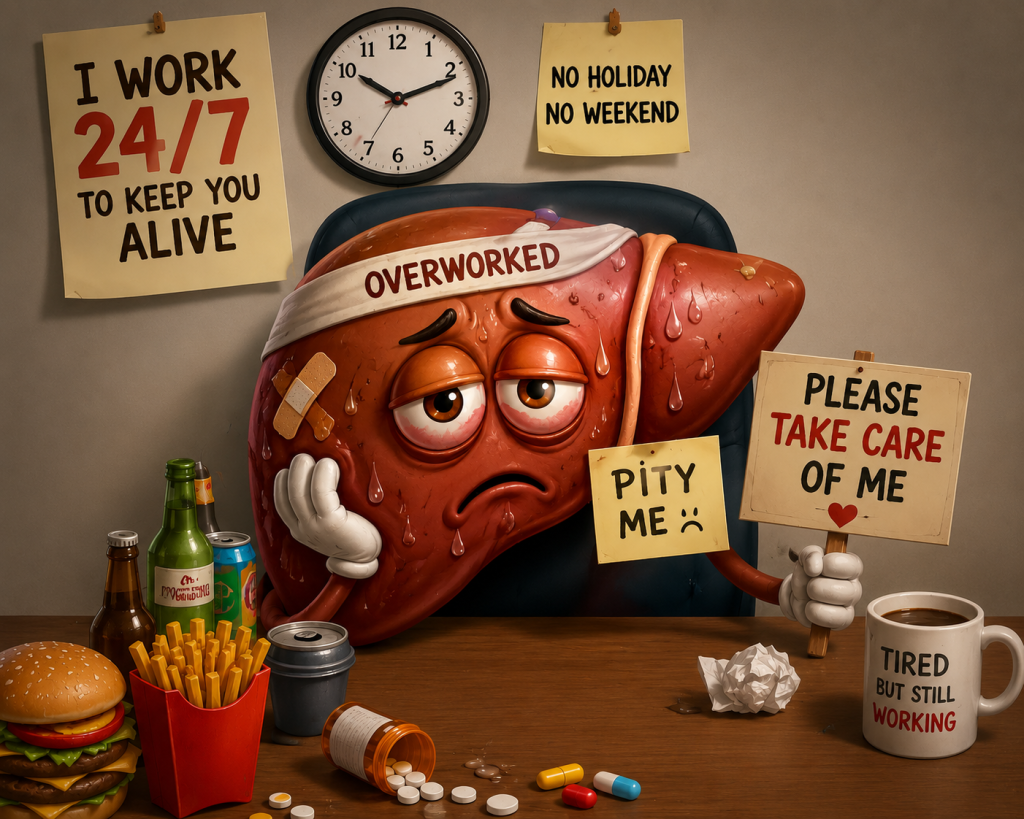
Let’s be honest.
Most of us have no idea what our liver actually does.
We know where the heart is. We know the stomach handles food. We know the brain is important because, well, everything falls apart without it.
But the liver?
The poor thing is just there, quietly minding its business.
Until somebody says, “The doctor found something in my liver,” and suddenly everyone becomes interested.
The truth is, if organs had office roles, the liver would be that one employee doing everybody else’s work.
No holidays.
No weekends.
No appreciation.
Just endless responsibilities.
Think about yesterday alone.
You woke up, had breakfast, drank tea or coffee, took a painkiller for that headache, inhaled traffic fumes, worried about bills, ate something fried in the evening, and maybe finished the day with a soft drink.
Guess who had to deal with all of that?
Your liver.
Every single bit of it.
Honestly, if the liver could speak, it might be asking for annual leave.
Your liver lives on the right side of your body, tucked under your ribs.
It’s big too.
About the size of a football, depending on the person.
And unlike some organs that have one or two clear jobs, the liver seems to have accepted every assignment nobody else wanted.
Scientists estimate that it carries out more than 500 different functions.
Five hundred!
Most people complain about handling two WhatsApp groups at once.
The liver is running an entire chemical empire.
Let’s clear something up.
The internet loves the word “detox.”
Detox teas.
Detox juices.
Detox diets.
Detox weekends.
Meanwhile, your liver is somewhere in the corner saying, “Excuse me, what exactly have I been doing all these years?”
Because this is literally its job.
Everything you eat, drink, swallow, breathe in, or put into your body eventually becomes your liver’s concern.
That painkiller?
The liver handles it.
That bottle of wine?
The liver gets involved.
Those herbal mixtures your uncle swears by?
Straight to the liver’s department.
Even natural substances need processing.
The liver is like customs officers at an international airport.
Nothing enters without inspection.
Nothing leaves without paperwork.
And somehow, it keeps everything moving.
Have you ever skipped lunch and still managed to function until evening?
You can thank your liver.
Whenever you eat more energy than your body needs immediately, the liver stores some of it away.
Not unlike a sensible Nigerian parent keeping extra rice in the freezer “just in case.”
Then, hours later, when your blood sugar starts dropping, the liver quietly releases some of those reserves.
No drama.
No announcement.
Just problem solved.
You don’t notice it.
But your body certainly does.
Here’s another thing people rarely think about.
Eating food is only half the battle.
Your body still has to figure out what to do with everything you’ve swallowed.
And once again, the liver shows up for work.
It produces bile, a substance that helps break down fats.
So when you’re enjoying a rich meal with fish, stew, oil, avocado, or anything deliciously heavy, your liver is already preparing for overtime.
Imagine hosting a huge family gathering every single day.
That’s basically what digestion feels like from the liver’s perspective.
This part genuinely amazes people.
The liver can regenerate.
Not in some science-fiction movie way.
But enough that if part of it is removed, the remaining section can grow and take on the workload.
Very few organs can pull off something like that.
Your kidneys?
Not really.
Your heart?
Definitely not.
The liver?
Absolutely.
It’s as if one employee resigned from the office and the remaining staff somehow learned every missing skill overnight.
Nature occasionally shows off, and the liver is one of its finest demonstrations.
Of course, even superheroes have limits.
Constant damage over many years can overwhelm its ability to recover.
Still, it remains one of the most resilient organs we possess.
One of the frustrating things about liver disease is that it often develops quietly.
The liver doesn’t complain much.
It keeps working.
Keeps adapting.
Keeps compensating.
By the time symptoms become obvious, significant changes may already have occurred.
It’s a bit like that dependable friend who never asks for help until they’re completely exhausted.
Which is why routine health checks matter.
Sometimes the body whispers long before it shouts.
Years ago, many people associated liver problems mainly with alcohol.
Today, things are more complicated.
Doctors are seeing increasing numbers of people with fatty liver disease who barely drink at all.
Modern lifestyles have changed the picture.
Less movement.
More processed foods.
Higher sugar consumption.
Long hours sitting.
Chronic stress.
Weight gain.
All these things place extra demands on an organ that already has enough responsibilities.
The good news?
The liver is remarkably forgiving.
Regular movement, balanced eating, managing chronic conditions, and giving the body proper rest can make an enormous difference.
It genuinely wants to recover.
You just have to give it the opportunity.
This conversation deserves honesty.
Many of us grew up around herbs, bitters, roots, and traditional preparations.
Some have been used for generations.
Some are currently being studied by scientists.
Some work.
Some do not.
And some can place unexpected stress on the liver.
Natural doesn’t automatically mean harmless.
Remember, the liver processes everything.
It doesn’t care whether a substance came from a laboratory or a forest.
Work is work.
So using remedies responsibly, seeking proper guidance, and avoiding unknown combinations is simply common sense.
Your liver already has enough on its plate.
The strange thing about being human is that we only notice the quiet workers when they stop working.
We celebrate the heart.
We admire the brain.
We complain about the stomach.
Meanwhile, the liver just keeps showing up every day without asking for recognition.
Cleaning.
Sorting.
Storing.
Building.
Repairing.
Protecting.
Five hundred jobs.
Twenty-four hours a day.
For an entire lifetime.
Not bad for an organ most people couldn’t accurately draw if asked.
So the next time you eat a meal, take medication, recover from an illness, or simply make it through another ordinary day, spare a thought for the hardest-working employee in your body.
And perhaps, every once in a while, make life a little easier for it.
It has certainly earned that much.