
I need to ask an important question.
Who else grew up believing that the moment somebody felt hot, it automatically meant malaria?
Because in my house, that was basically the national protocol.
Touch forehead.
Confirm heat.
Everybody becomes serious.
One person is already looking for a thermometer. Another is recommending a herbal remedy. Somebody else is saying, “Cover up well and sweat it out.”
Meanwhile, the person with the fever is just lying there, wondering why the room suddenly feels like Antarctica.
Honestly, fever is one of those things we have all experienced but rarely stop to understand.
And here’s the funny part.
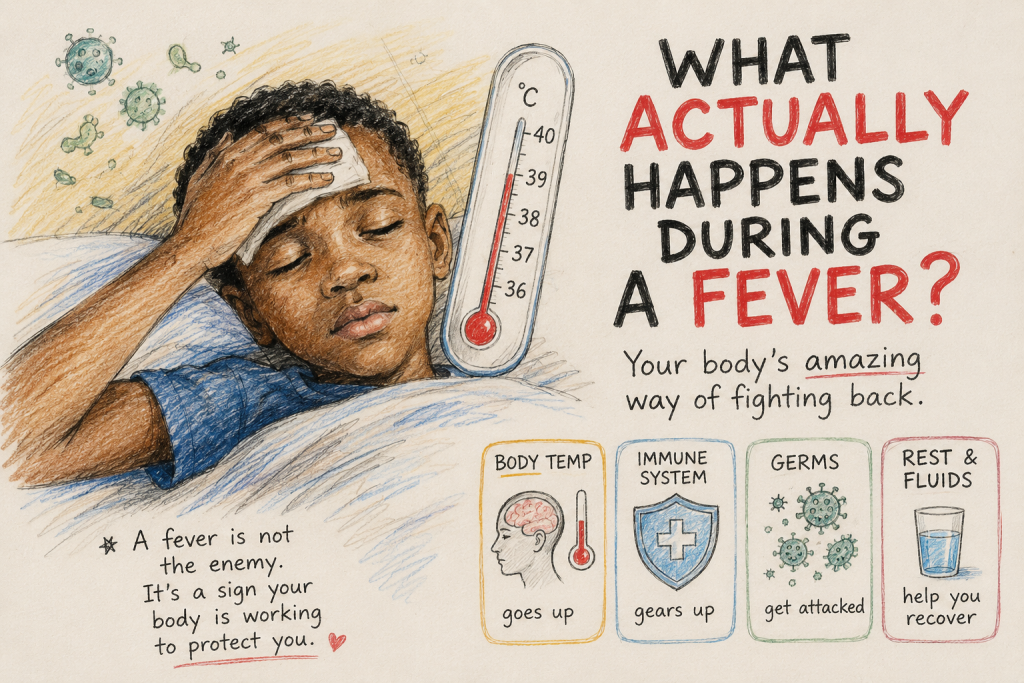
A fever is usually not the problem.
Most of the time, it’s evidence that your body has noticed something suspicious and has already started dealing with it.
Which, when you think about it, is actually pretty impressive.
Your body doesn’t wait around for a committee meeting.
It sees trouble and immediately starts making plans.
Let’s talk about it.
First of all, your body absolutely loves routine
Human beings like routine.
Apparently, our bodies are even worse.
Your body wants its temperature to stay within a very specific range, roughly around 37°C.
Not 35.
Not 40.
Just there.
Steady.
Reliable.
Somewhere deep inside your brain is a tiny region called the hypothalamus.
Forget the complicated name.
Think of it as your body’s thermostat.
It’s basically that one friend in every group who insists on keeping everything organized.
Too cold?
Problem.
Too hot?
Also a problem.
The thermostat notices everything.
Day and night.
Without taking breaks.
Then one day, a virus or bacterium shows up and ruins everybody’s peace.
And the thermostat says:
“Alright everyone, new plan. Turn up the heat.”
Wait. The body does this on purpose?
Yep.
Completely intentional.
Which sounds a little ridiculous at first.
Because who enjoys having a fever?
Absolutely nobody.
But many germs prefer normal body temperatures.
Your immune system understands this.
So one of its oldest tricks is to make the environment less comfortable for unwanted visitors.
Imagine somebody showing up uninvited to your house and you suddenly switching off the fan in the middle of April.
They’re probably not staying long.
Your body is doing something similar.
It raises the temperature and essentially says:
“If you’re going to live here, we’re making things difficult.”
Honestly, I respect the strategy.
And this explains one of life’s great mysteries
Why on earth do we shiver when we already have a fever?
Seriously.
How can someone be burning hot and still asking for another blanket?
It makes absolutely no sense.
Until you understand what’s happening.
Remember that thermostat in your brain?
Well, it has changed the target temperature.
So even though everyone around you thinks you’re roasting, your body thinks:
“Excuse me, we’re still below the new setting. More heat, please.”
And so your muscles begin to shiver.
Tiny contractions.
Over and over.
Generating extra warmth.
Meanwhile, your mother walks into the room and says:
“Why are you covering yourself? You’re already hot!”
Both of you are right.
The human body is wonderfully dramatic sometimes.
Also… why does fever make us feel so tired?
This one used to annoy me.
You get a fever and suddenly lifting a cup feels like manual labour.
Walking to the bathroom becomes an expedition.
All you want to do is sleep.
Turns out your body is spending a ridiculous amount of energy fighting.
Think about it.
Your immune cells are communicating.
Producing chemicals.
Identifying threats.
Coordinating responses.
Cleaning up damaged cells.
It’s basically an emergency operation happening twenty-four hours a day.
No wonder you’re exhausted.
If an entire city redirected its resources toward handling a crisis, people would expect regular activities to slow down.
The same thing happens inside you.
So if your body says:
“Please lie down.”
Maybe listen.
Sometimes rest isn’t laziness.
Sometimes it’s teamwork.
The appetite disappearing act
Now let’s address another mystery.
Why does food suddenly become uninteresting when we’re sick?
The same person who happily demolished a plate of jollof rice yesterday suddenly wants nothing more than water and sleep.
Parents everywhere know this struggle.
“Just eat something.”
“Even a little.”
“At least take one spoon.”
Meanwhile, the child is looking at the food like it’s a difficult mathematics problem.
Scientists are still studying every detail behind this, but one explanation is that the body temporarily shifts priorities.
Digestion requires effort.
Fighting infections requires effort.
And right now, the immune system is winning the argument over resource allocation.
Hydration remains important, of course.
Very important.
But a short-term drop in appetite during illness is incredibly common.
Your body is busy.
It has other things on its mind.
Let’s settle something once and for all
Not every fever means malaria.
I know.
This statement alone might start family debates.
Malaria absolutely causes fever.
But so do many other things.
Viruses.
Bacterial infections.
Inflammation.
Various medical conditions.
Fever itself is not a diagnosis.
It’s more like a notification.
Your body saying:
“Hello. Something unusual is happening over here. Please investigate.”
The challenge is figuring out exactly what that something is.
Which is why proper medical evaluation matters.
Guesswork can only take us so far.
Should we panic every single time?
Probably not.
Should we ignore it?
Also no.
The truth, as usual, lives somewhere in the middle.
A mild fever in an otherwise healthy adult may simply require rest, fluids, and patience.
But context matters.
The age of the person matters.
How high the temperature is matters.
How long it lasts matters.
The symptoms that come with it matter.
A newborn with a fever deserves immediate attention.
A person struggling to breathe deserves immediate attention.
Confusion, severe weakness, or persistent symptoms deserve attention too.
The body is clever.
But it also appreciates backup when situations become complicated.
Here’s the part that amazes me
Before modern hospitals existed…
Before antibiotics…
Before thermometers…
Human beings still had immune systems doing incredible things.
For thousands of years, the body has been detecting threats and organizing defences without requiring our permission.
Think about that for a second.
Right now, as you read this, countless processes are happening inside you.
Cells communicating.
Chemicals moving.
Information being shared.
Problems being solved.
Entire systems cooperating.
And most of the time, we don’t notice any of it.
We just carry on with our day.
A fever is one of those rare moments when the body says:
“Actually, I’d like your attention for a minute.”
It’s uncomfortable.
It’s inconvenient.
Nobody enjoys it.
But in many cases, it represents something remarkable.
Your internal security team has identified a problem and immediately gone to work.
No meetings.
No delays.
No bureaucracy.
Just action.
And honestly?
That’s something worth appreciating.
The next time someone in your home develops a fever, there is every reason to take it seriously.
But maybe, alongside the concern, there can also be a little wonder.
Because what feels frightening on the outside is often evidence of something extraordinary happening on the inside.
Your body noticed trouble.
And before you even realized what was going on, it had already started fighting back.