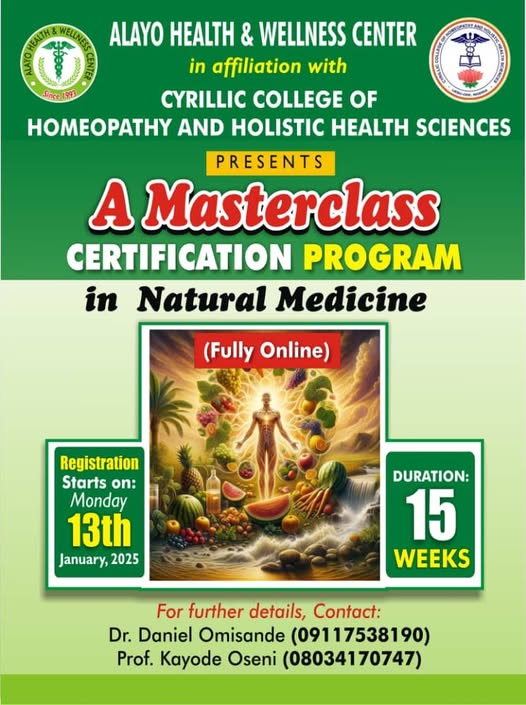
INTRODUCING: MASTER CLASS IN NATURAL MEDICINE
(Organized by Alayo Health & Wellness Center, in affiliation with Cyrillic College of Homeopathy And Holistic Health Sciences)
Fully Online
Course Structure:
– Lectures will be conducted via Telegram, serving as our digital blackboard where all materials will be posted.
– Students are required to copy the lecture content and paste it onto a separate platform for easier access and review.
Teaching Resources:
– Video links (YouTube)
– Direct video clips for practical demonstrations
– E-books
– Images and visual aids
Lecture Schedule:
Lectures will be posted on Mondays, Wednesdays, Fridays, and Saturday evenings.
Questions related to the lectures will be addressed on Tuesdays, Thursdays, and Sunday evenings.
Assignments and Projects:
– Assignments based on the lectures will be assigned periodically and should be submitted privately to me within 24 hours of issuance.
– Active participation in class will account for 15% of the final exam grade.
– Class assignments will contribute 25% to the final exam grade.
15-Week Online Masterclass Curriculum in Naturopathic Medicine
Program Overview:
This masterclass program offers a comprehensive exploration of Naturopathic Medicine, focusing on Herbal Medicine, Energy Medicine, and Basic Human Anatomy and Physiology. Designed for both professionals in natural medicine and interested individuals with diplomas or degrees in other disciplines, this course integrates theoretical knowledge and practical skills essential for understanding and applying Naturopathic principles.
Weekly Breakdown:
Week 1: Introduction to Naturopathic Medicine
– Overview of Naturopathic philosophy and principles
– Historical context and development of Naturopathic Medicine
– Scope of practice and roles of naturopathic practitioners
Week 2: Fundamentals of Herbal Medicine
– Introduction to herbal medicine: Terminology and history
– Overview of common herbal remedies and their uses
– Safety, side effects, and contraindications in herbal medicine
Week 3: Herbal Preparations and Formulas
– Types of herbal preparations: teas, tinctures, extracts, and capsules
– Principles of creating herbal formulas
– Practical session: preparation of herbal remedies (video demonstration)
Week 4: Energy Medicine Basics
– Introduction to energy medicine: concepts and theories
– Different modalities of energy medicine (e.g., Reiki, acupuncture, Qi Gong)
– The role of energy in healing and health
Week 5: Energy Medicine Practices
– Practical applications of energy medicine
– Hands-on techniques for balancing energy (video demonstration)
– Case studies on energy medicine efficacy
Week 6: Basic Human Anatomy
– Overview of human anatomical systems: structure and function
– Introduction to body systems: musculoskeletal, cardiovascular, digestive, and respiratory systems
– Interactive anatomy resources and tools
Week 7: Basic Human Physiology
– Understanding physiological functions in relation to health and disease
– Homeostasis and the body’s responses to stressors
– Integrating anatomy and physiology in Naturopathic practice
Week 8: Nutrition and Dietary Practices
– Principles of nutrition in Naturopathic Medicine
– Understanding dietary interventions and their therapeutic use
– Herb-nutrient interactions and their impact on health
Week 9: Integrative Approaches to Disease
– Naturopathic approaches to common health conditions (e.g., diabetes, hypertension)
– Case studies demonstrating integrative therapies
– Assessing patient history and conditions holistically
Week 10: Diagnosis and Treatment Planning
– Introduction to diagnostic techniques in Naturopathic Medicine
– Developing effective treatment plans for clients
– Ethical considerations in patient care
Week 11: Clinical Skills Development
– Communication and consultation skills for practitioners
– Conducting patient assessments and follow-ups
– Building a patient-centered practice: rapport and trust
Week 12: Complementary Therapies and Techniques
– Overview of additional therapies: acupuncture, homeopathy, and lifestyle counseling
– Integration of multiple modalities for comprehensive care
– Evidence-based practices in natural medicine
Week 13: Research and Evidence in Naturopathy
– The importance of research in Naturopathic Medicine
– Understanding clinical trials and studies on herbal and alternative therapies
– Evaluating scientific literature and its application to practice
Week 14: Establishing a Naturopathic Practice
– Essentials of setting up a Naturopathic practice
– Business considerations and practice management
– Marketing strategies for attracting and retaining clients
Week 15: Review and Final Assessment
– Review of key concepts from the course
– Final assessment – Project or examination to demonstrate mastery of course material
– Graduation and discussion of next steps in professional development
Teaching Methods:
– Weekly recorded lectures and live Q&A sessions
– Video demonstrations and practical assignments
– Interactive discussions in forums and peer collaboration
– Supplementary readings and resources
Conclusion:
This comprehensive 15-week masterclass provides a strong foundation in Naturopathic Medicine, preparing participants to effectively apply their knowledge and skills in various professional settings. The curriculum is designed to foster both theoretical understanding and practical application, ensuring that graduates are well-equipped to serve their communities in the field of natural medicine.