
Most people have experienced it without fully noticing what was happening.
A difficult week at work suddenly comes with headaches that refuse to leave. Someone goes through months of emotional pressure and develops back pain that was never there before. Another person notices their stomach tightening during stressful conversations. Sleep becomes lighter. Muscles stay tense for no obvious reason. Even old injuries sometimes begin hurting again during emotionally difficult periods.
The body has strange ways of reacting to pressure.
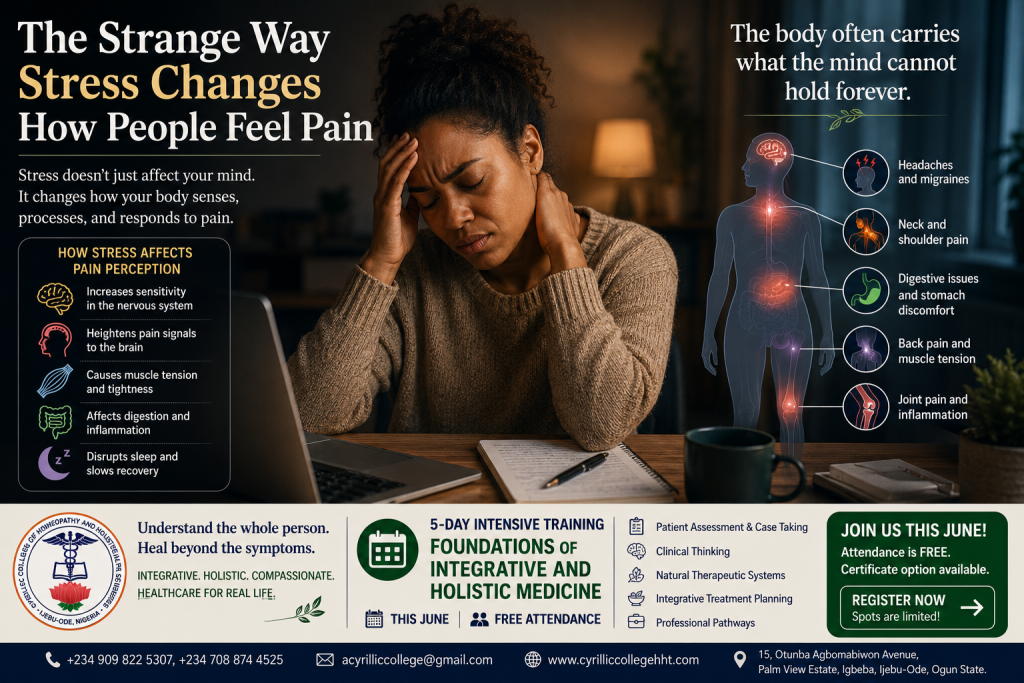
For a long time, stress was treated almost like a purely emotional experience. Something happening in the mind. Something psychological. But modern understanding of the nervous system paints a more complicated picture. Stress does not simply affect mood. It changes the way the body interprets discomfort, tension, inflammation, and pain itself.
In many cases, stress does not create pain out of nowhere. It amplifies what already exists quietly in the background.
That is part of what makes it so difficult to recognize.
People often search for a physical explanation first because physical pain feels concrete. Understandably so. If the neck hurts, attention goes to posture. If the stomach reacts badly, attention goes to food. If headaches become frequent, people start changing screens, lighting, or medications.
Sometimes those factors matter. Sometimes they matter a lot.
But there are also moments when the nervous system itself has become overloaded.
And once that happens, the body can begin responding to ordinary sensations as if they are threats.
Anyone who has lived through a prolonged stressful season has probably noticed how physical the experience can become. The jaw stays clenched without realizing it. Breathing becomes shallow. Shoulders tighten. Sleep stops feeling restorative. Small discomforts suddenly feel much larger than they normally would.
Then something interesting happens.
When the stressful period finally passes, some of those symptoms fade surprisingly quickly.
Not always completely. Not magically. But enough to reveal that the body had been carrying far more tension than the person realized.
This relationship between stress and pain has become increasingly important in conversations around chronic illness, burnout, and modern healthcare. Many practitioners now recognize that pain is not always just about tissue damage or structural problems. The nervous system itself plays a major role in how pain is experienced.
Two people can have similar injuries and report very different levels of pain. One recovers steadily while the other struggles for months. Sometimes the difference is not simply physical. Emotional strain, fear, anxiety, sleep deprivation, and prolonged stress can all shape how the nervous system processes discomfort.
This does not mean the pain is imaginary.
That misunderstanding has frustrated many patients for years.
People in chronic pain are often told things like:
You are overthinking it.
It is just stress.
Try to relax.
But anyone who has lived with persistent pain knows how dismissive that can sound.
The pain is real.
What researchers and clinicians increasingly understand, however, is that emotional pressure and physiological pain are far more connected than many people once believed.
The nervous system does not separate life neatly into mental and physical categories. The body experiences human life as one continuous experience.
A period of grief can affect appetite. Anxiety can alter digestion. Burnout can disturb sleep for months. Chronic pressure can raise muscle tension so consistently that pain becomes part of daily life.
Modern living does not help either.
Many people now spend years in low-grade states of constant stimulation. Notifications never stop. Attention is fragmented. Financial pressure remains high. Rest is interrupted. Even moments that should feel quiet often come filled with screens, noise, or information.
The body was never designed for permanent alertness.
And yet for many people, that has quietly become normal.
One of the more fascinating things about stress is how differently it affects individuals. Some people develop migraines. Others experience digestive issues. Some develop fatigue that sleep does not fully fix. Others notice skin flare-ups, body aches, chest tightness, or worsening inflammatory conditions during emotionally difficult periods.
The body tends to reveal stress through its most vulnerable systems.
That is partly why healthcare practitioners who work closely with chronic conditions often spend time asking questions that seem unrelated at first glance.
How has sleep been recently?
What has work been like?
Have there been major emotional changes?
When did the symptoms first begin?
What was happening in life around that time?
Sometimes those questions reveal patterns that scans and laboratory tests alone cannot fully capture.
This broader style of patient evaluation has become increasingly important within integrative and holistic healthcare, especially in the management of chronic stress related conditions.
Not because every illness is caused by stress. That would be simplistic.
But because human health is rarely shaped by one factor alone.
Lifestyle, emotional strain, sleep quality, nervous system regulation, nutrition, environment, and physical health constantly interact with one another. Ignoring those relationships can leave important pieces of the picture unexplored.
Interestingly, many patients already sense this intuitively before they can explain it scientifically.
They notice their pain worsens during emotionally exhausting periods. They notice flare-ups during conflict, overwork, grief, or prolonged anxiety. They notice that proper rest, emotional stability, supportive relationships, and healthier routines sometimes improve symptoms more than expected.
The body notices everything.
Sometimes even before the mind fully catches up.
As interest in stress physiology, nervous system health, and integrative medicine continues to grow, more healthcare professionals are beginning to explore approaches that look beyond isolated symptoms and examine the broader patterns influencing health and recovery.
This June, Cyrillic College of Homeopathy and Holistic Health Sciences will host a 5 Day Intensive Training on Foundations of Integrative and Holistic Medicine.
The program will explore areas such as patient assessment, clinical thinking, holistic healthcare principles, and integrative treatment approaches used in modern complementary healthcare practice.
Attendance is free.
For people curious about the deeper relationship between stress, health, and the human body, it may be an interesting place to begin learning.
Registration link:
https://docs.google.com/forms/d/e/1FAIpQLSfDKIHIlPeSdn3d-RUBrVTqky5U5RZelhSZ_lSUEGBSYKUYrQ/viewform?usp=header