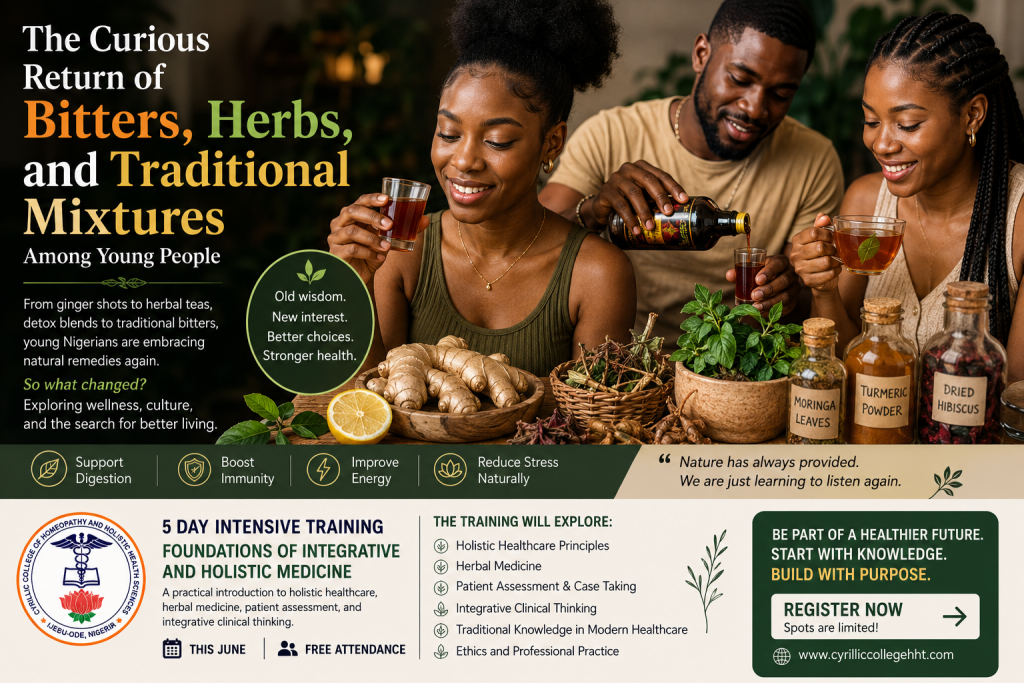
Something interesting has been happening quietly over the past few years.
Young people who grew up laughing at herbal mixtures are now drinking them voluntarily.
Bitters have returned to refrigerators. Ginger shots are suddenly fashionable. Turmeric, garlic, cloves, moringa, scent leaf, black seed oil, and all kinds of homemade mixtures now appear regularly in conversations that once revolved entirely around fast food, soft drinks, and imported supplements.
Even people who once dismissed traditional remedies as outdated now speak about detoxing, cleansing, boosting immunity, reducing inflammation, or “going natural.”
It is a noticeable shift.
And it says something deeper about the moment people are living in.
Part of this change is happening because modern wellness culture has become deeply influential. Social media is filled with conversations about gut health, processed food, artificial ingredients, hormones, energy levels, fatigue, and long-term health risks. Younger generations are constantly exposed to advice about healthier living, sometimes helpful, sometimes wildly confusing.
But beneath the trends and wellness language, something more interesting seems to be happening.
People are becoming suspicious of modern living itself.
Many young adults feel permanently tired. Sleep feels lighter. Energy disappears faster. Attention spans feel shorter. Fast food is convenient but often leaves people feeling sluggish afterward. More people are worried about blood pressure, blood sugar, inflammation, stress, digestion, and chronic illness at younger ages than previous generations expected.
So naturally, many begin looking backward as much as forward.
And when they look backward, they find older practices waiting there.
The funny thing is that many of these remedies never actually disappeared. They simply lost social status for a while. There was a period when anything associated with traditional healing was often treated as primitive, unscientific, or something only older relatives believed in.
Now the same generation that once mocked agbo is buying expensive wellness shots containing ingredients their grandparents used decades ago.
The packaging changed.
The language changed.
The branding changed.
But some of the ingredients remained surprisingly familiar.
You can see this shift almost everywhere now.
Fitness enthusiasts drink herbal blends for energy and recovery. Young professionals struggling with stress turn toward natural teas and bitters. Social media influencers discuss cleansing routines and anti-inflammatory foods. Markets that once sold herbs quietly now attract younger customers asking questions about digestion, sleep, immunity, skin health, and hormonal balance.
Even conversations around alcohol are changing. Many people who once consumed bitters casually now speak about herbs less as recreational drinks and more as part of a wellness lifestyle.
Of course, not everything marketed as natural is automatically healthy.
That is where things become complicated.
Modern wellness culture moves very quickly, and sometimes faster than proper understanding. One week everybody is taking activated charcoal. The next week chlorophyll water becomes the miracle solution for everything. Then suddenly every health problem online is blamed on inflammation, gut imbalance, or toxins.
Some claims are exaggerated.
Some mixtures are poorly regulated.
Some people self-medicate carelessly.
And social media has made health confidence incredibly easy to fake.
A person with good lighting and persuasive captions can suddenly become a wellness authority overnight.
Still, despite the confusion, the larger movement itself is fascinating because it reflects something real.
People want to feel connected to their health again.
Many are tired of feeling disconnected from what they eat, drink, and consume daily. There is growing curiosity around prevention, vitality, energy, and long-term wellbeing. Younger generations are asking questions previous generations often ignored until illness appeared.
That curiosity is not necessarily a bad thing.
In some ways, it reflects a broader cultural shift happening globally. Around the world, interest in traditional medicine, herbal systems, food based healing, and integrative healthcare has grown steadily over the last decade. Practices once considered fringe now appear inside wellness clinics, research conversations, fitness spaces, and even mainstream healthcare discussions.
Part of the reason is simple.
Modern people are overwhelmed.
Life feels chemically dense, digitally noisy, emotionally fast, and physically exhausting. In response, many people are searching for things that feel more grounded, familiar, and natural.
Sometimes that search leads them back to older knowledge systems.
Not blindly.
Not perfectly.
But curiously.
And perhaps that curiosity deserves more thoughtful conversation than it usually receives.
Because somewhere between blind skepticism and blind belief, there is room for serious learning.
There is room to ask:
What traditional practices actually hold value?
What deserves scientific investigation?
What should be approached carefully?
What can modern healthcare learn from older healing systems?
How should traditional knowledge evolve responsibly in a modern world?
Those are increasingly important questions, especially in countries like Nigeria where traditional and modern healthcare realities constantly intersect in everyday life.
This growing interest in natural and integrative approaches to health is one reason conversations around holistic healthcare education have also expanded in recent years.
This June, Cyrillic College of Homeopathy and Holistic Health Sciences will host a 5 Day Intensive Training on Foundations of Integrative and Holistic Medicine.
The workshop will explore areas such as holistic healthcare principles, herbal medicine, patient assessment, integrative clinical thinking, and the evolving relationship between traditional healing systems and modern healthcare practice.
Attendance is free.
For many people, curiosity about herbs and natural health starts casually.
Sometimes with ginger.
Sometimes with bitters.
Sometimes with a conversation at home.
But curiosity often grows deeper once people begin asking better questions.
Registration link:
https://docs.google.com/forms/d/e/1FAIpQLSfDKIHIlPeSdn3d-RUBrVTqky5U5RZelhSZ_lSUEGBSYKUYrQ/viewform?usp=header