
When people think about the factors that shape human health, the usual suspects come to mind quickly. Diet. Exercise. Genetics. Access to medical care. Environmental exposure.
These are all important. Yet in recent years, researchers have begun paying closer attention to another influence that is far less discussed but increasingly difficult to ignore.
Loneliness.
For a long time, loneliness was treated primarily as a social or emotional experience. Something unfortunate, perhaps painful, but not necessarily a matter of medical concern.
Today, the evidence tells a different story.
Loneliness is emerging as a significant determinant of health, affecting the body in ways that extend far beyond mood or emotional wellbeing.
Loneliness Is Not the Same as Being Alone
One of the first things researchers discovered when studying loneliness is that it has less to do with the number of people around us and more to do with the quality of our connections.
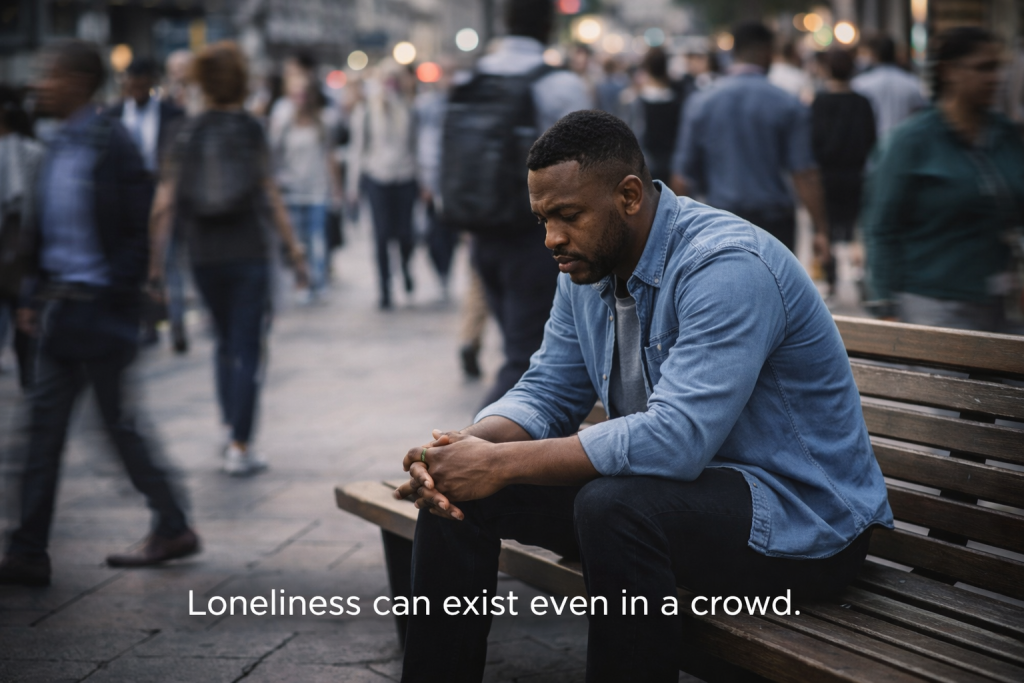
A person can live in a busy household, work in a crowded office, and interact with dozens of people each day yet still feel deeply isolated.
Loneliness occurs when meaningful connection is missing. It reflects a gap between the relationships people have and the relationships they need.
In this sense, loneliness is not simply a social condition. It is a psychological and biological experience.
The Body Responds to Social Isolation
Human beings are inherently social. For most of human history, survival depended on belonging to a group. Isolation could mean danger, vulnerability, or lack of protection.
Because of this evolutionary history, the human nervous system reacts strongly to social disconnection.
When loneliness persists, the body often shifts into a state of heightened vigilance. Stress hormones may increase. Sleep patterns can become disrupted. The immune system may begin to function less efficiently.
Over time, these physiological changes can affect multiple systems in the body.
Researchers have linked chronic loneliness to increased risk of cardiovascular disease, weakened immune function, cognitive decline, depression, and even earlier mortality.
The effects are not merely emotional. They are biological.
A Quiet but Widespread Problem
Loneliness is often described as a hidden epidemic. Unlike infectious disease or obvious injury, it leaves no visible mark. Many people experience it silently.
Modern life has introduced several factors that can increase the risk of social isolation.
Urban living, while offering opportunity and convenience, can sometimes reduce the sense of community that smaller social environments once provided.
Work patterns have also changed. Remote work, long commuting hours, and demanding schedules can limit time for family interaction and social engagement.
Digital communication has expanded rapidly, allowing people to connect instantly across distances. Yet digital connection does not always replace the emotional depth of face to face relationships.
In some cases, constant digital interaction can create the illusion of connection while leaving deeper social needs unmet.
The Health Consequences of Loneliness
The growing body of research surrounding loneliness has produced some striking findings.
Studies suggest that chronic loneliness may be associated with increased risk of high blood pressure, cardiovascular disease, and inflammatory responses in the body.
Sleep quality is also affected. Individuals experiencing loneliness often report more fragmented sleep and lower overall sleep satisfaction.
Mental health is closely intertwined with these effects. Persistent loneliness increases vulnerability to anxiety, depression, and cognitive decline over time.
Perhaps most striking is the finding that long term social isolation may carry health risks comparable to other well established factors such as smoking or physical inactivity.
These findings are encouraging researchers and clinicians to reconsider how social wellbeing fits into the broader picture of health.
The Role of Community in Health
If loneliness contributes to disease risk, the presence of strong social connections can have the opposite effect.
Communities that foster trust, belonging, and regular social interaction often demonstrate better overall health outcomes.
Family networks, friendship circles, religious communities, and professional support groups can all provide important forms of social support.
These connections offer more than companionship. They influence behaviour, encourage healthy habits, and provide emotional resilience during times of stress.
A person who feels supported is often more likely to seek medical care when needed, adhere to treatment plans, and maintain healthier lifestyle patterns.
In this sense, community functions as a form of preventive health infrastructure.
What This Means for Healthcare Practitioners
For practitioners working in healthcare, the emerging research on loneliness offers an important reminder that health does not exist in isolation from the social environment.
Symptoms presented in the clinic often reflect a complex interaction of biological, psychological, and social influences.
A patient struggling with chronic fatigue, sleep disturbance, anxiety, or persistent stress may also be navigating significant social disconnection.
Recognizing this dimension does not replace medical diagnosis or treatment. Instead, it broadens the context in which health problems are understood.
Simple questions about social support, living conditions, and community engagement can sometimes reveal underlying challenges that influence patient wellbeing.
Healthcare, at its best, acknowledges the full complexity of human life.
Rebuilding Connection in a Modern World
Addressing loneliness is not as simple as telling people to “be more social.” Modern schedules, economic pressures, and geographic mobility can make building strong relationships more difficult than it once was.
Yet small shifts can make meaningful differences.
Regular contact with friends and family, participation in community activities, shared meals, volunteer work, and professional networks all help create opportunities for connection.
Even simple routines such as walking with a friend, joining a local group, or participating in community events can gradually strengthen social bonds.
For many people, rebuilding connection begins with small, consistent steps rather than dramatic changes.
A Broader View of Health
The growing conversation around loneliness reminds us that health is shaped by far more than biology alone.
Human beings are social creatures whose wellbeing depends on relationships, community, and a sense of belonging.
As healthcare continues to evolve, understanding these broader influences becomes increasingly important.
Medicine may treat disease, but health itself emerges from a complex web of physical, emotional, and social factors.
Loneliness may be quiet and often invisible, but its effects are real.
Recognizing it as a determinant of health is one step toward building a more complete understanding of what it means for individuals and communities to truly thrive.